Malacostraca |
Decapoda |
Crangonidae
पर्यावरण: पर्यावरण / जलवायु क्षेत्र / गहराई सीमा / वितरण सीमा
पारिस्थितिकी
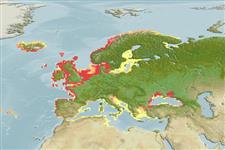
Benthic; खारा; गहराई सीमा 0 - 50 m (संदर्भ 434). Subtropical, preferred 11°C (संदर्भ 107945); 74°N - 23°N, 16°W - 44°W
Northeast Atlantic and the Mediterranean.
प्रथम परिपक्वता पर लंबाई / आकार / वज़न / आयु
परिपक्व अवधि: Lm ? range ? - ? cm Max length : 8.9 cm TL पुल्लिंग / अलिंग; (संदर्भ 434)
Found in both marine and oligohaline waters (Ref. 95752). Also inhabits brackish lagoons (Ref. 2779). Found on fine sand or slightly muddy sand (Ref. 434); also over coarse sand (Ref. 96391). Juveniles are epifaunal on seagrass and bare sand flats (Ref. 106879). Mobile (Refs. 95752, 96470). Free-living (Ref. 3123). Able to occupy areas with high exposure and low salinity (Ref. 95730). Carnivorous (Refs. 95752, 96470). Feeds on small benthic organisms (small crustaceans, annelids and mollusks) and fishery discards (Ref. 434).
जीवन चक्र और संभोग व्यवहार
परिपक्व अवधि | पुनरुत्पत्ति | मछलीऔ का अंडे देना | अंडे | उपजाऊपन | लार्वा
Members of the order Decapoda are mostly gonochoric. Mating behavior: Precopulatory courtship ritual is common (through olfactory and tactile cues); usually indirect sperm transfer.
Fischer, W., G. Bianchi and W.B. Scott (eds.) 1981 Shrimps and prawns. 6: pag.var. In FAO species identification sheets for fishery purposes. Eastern Central Atlantic (Fishing Area 34, 47; in part). Canada Funds-in-Trust. Ottawa, Department of Fisheries and Oceans Canada, by arrangement with the Food and Agriculture organization of the United Nations. 1-7: pag.var. (संदर्भ 434)
आईयूसीएन रेड लिस्ट स्थिति
(संदर्भ 130435: Version 2025-2 (Global))
CITES स्थिति (संदर्भ 108899)
Not Evaluated
CMS (संदर्भ 116361)
Not Evaluated
मनुष्यों के लिए ख़तरा
मानव उपयोग
मात्स्यिकी: व्यापारिक
FAO - मात्स्यिकी: प्रजातियों की प्रोफ़ाइल, landings search; Publication: search | FishSource | हमारे चारों ओर समुद्र
साधन
अधिक जानकारी
मानव संबंधीटिकट, सिक्के, विविध.
इंटरनेट स्रोत
मॉडल पर आधारित अनुमान
लौटाव
(Ref. 69278): |
ऊंचा, न्यूनतम जनसंख्या दुगनी समय अवलागत 15 महीने। (K=0.90-1.09) |
मछली पकड़ने की भेद्यता
(संदर्भ 71543) |
Low vulnerability (10 of 100). |
जलवायु भेद्यता
(संदर्भ 125649) |
Moderate vulnerability (37 of 100) |
मूल्य श्रेणी
(संदर्भ 80766): |
Very high. |
Nutrients
|
Calcium = 109 [35, 184] mg/100g; Iron = 1.59 [1.21, 1.97] mg/100g; Protein = 20.2 [19.2, 21.3] %; Omega3 = 0.285 [0.185, 0.386] g/100g; Selenium = 48.3 [-31.7, 128.3] μg/100g; VitaminA = 0 μg/100g; Zinc = 1.79 [1.17, 2.40] mg/100g (wet weight); based on nutrient studies. |