Malacostraca |
Decapoda |
Portunidae
Miljö: miljö / Klimatzon / djupintervall / distributionsområde
Ekologi
Bentopelagisk; brackvatten; djupintervall 0 - 75 m (Ref. 367). Tropical, preferred 26°C (Ref. 107945); 35°N - 38°S, 98°W - 34°W
Western Atlantic: USA to Argentina.
Längd vid första mognad / Storlek / Vikt / Ålder
Könsmognad: Lm 59.5 range ? - ? cm Max length : 13.9 cm CW hane/ej könsbestämd; (Ref. 367); 11.3 cm CW (female); rapporterad maxålder: 2.50 år (Ref. 85497)
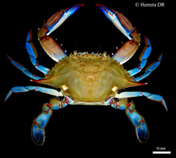
Carapace slightly more than twice as broad as long; 9 teeth on arched anterolateral margin 9outer orbital tooth and strong lateral spine included) progressively more acuminate laterally; outer pair of frontal teeth (excluding inner orbital angles) prominent but inner pair small. Much of convex dorsal surface lightly granulate, most prominently so on anterior and elevated areas and in transverse lines; central trapezoidal (metagastric) area short and wide (anterior width about 2 to 2.5 times, posterior width about 1.5 times length). Pincers dissimilar, ridged longitudinally; fifth legs flattened in form of paddles. Male with T-shaped abdomen reaching slightly beyond suture between thoracic sternites 4 and 5; first pleopods reaching beyond midpoint of thoracic 6, nearly straight distally except for merabranous tips usually bent ventrolaterally, armed with scattered, minute, mainly dorsal spinules and 2 to 4 subterminal, exceedingly slender, elongate sternomesial spinules. Color: variably olive to greyish blue dorsally, spines olive to indigo and white-tipped; pincers with variable blue to purple on upper and inner surfaces, olive to blue externally; legs predominantly dark blue to azure or greenish, underparts white. Some individuals are duller and some have a reticulate pinkish blue cast on the upper surface of chelipeds.
Minimum carapace width: 3 cm (Ref. 93549). Maximum length of female from Ref. 85497. Inhabits a wide range of habitats from muddy estuaries in mangroves and algae-covered broken shell bottom, to beaches and open ocean depths down to 75 m (Ref. 367). Also found on seagrass bare sand (Ref. 102062). Tolerant of salinities ranging from fresh to hypersaline. Feeds on mollusks, other bottom invertebrates, and some fishes, carrion and detritus (Ref. 367).
Livscykel och parningsbeteende
Könsmognad | Reproduktion | Lek | Ägg | Fekunditet | Larver
Members of the order Decapoda are mostly gonochoric. Mating behavior: Precopulatory courtship ritual is common (through olfactory and tactile cues); usually indirect sperm transfer.
Tavares, M. 2003 True Crabs. pp. 327-352. In Carpenter, K.E. (ed.) The living marine resources of the Western Central Atlantic. Volume1: introdution, molluscs, crustaceans, hagfishes, sharks, batoid fishes, and chimaeras. FAO Species Identification Guide for Fishery Purposes and American Society of Ichthyologists and Herpetologists Special PublicationNo. 5. Rome, FAO. pp. 1-600. (Ref. 367)
Status på IUCN:s rödlista
(Ref. 130435: Version 2025-2 (Global))
CITES-status (Ref. 108899)
Not Evaluated
Not Evaluated
Hot mot människor
Mänskliga användningsområden
Fiskeri: kommersiell
FAO - fiskeri: landings search; Publication: search | FishSource | Havet omkring oss
Verktyg
Ytterligare information
MänniskorelateradFrimärken, mynt, diverse.
Internet-källor
Uppskattningar baserade på modeller
Resiliens
(Ref. 69278): |
Hög, lägsta populationsfördubblingstid mindre än 15 månader (K=1.83; tmax=2.5) |
Sårbarhet i fisket
(Ref. 71543) |
Low vulnerability (16 of 100). |
Sårbarhet för klimatet
(Ref. 125649) |
Moderate to high vulnerability (51 of 100) |
Priskategori
(Ref. 80766): |
Low. |
Nutrients
|
Calcium = 109 [35, 184] mg/100g; Iron = 1.59 [1.21, 1.97] mg/100g; Protein = 20.2 [19.2, 21.3] %; Omega3 = 0.285 [0.185, 0.386] g/100g; Selenium = 48.3 [-31.7, 128.3] μg/100g; VitaminA = 0 μg/100g; Zinc = 1.79 [1.17, 2.40] mg/100g (wet weight); based on nutrient studies. |