Malacostraca |
Decapoda |
Portunidae
पर्यावरण: पर्यावरण / जलवायु क्षेत्र / गहराई सीमा / वितरण सीमा
पारिस्थितिकी
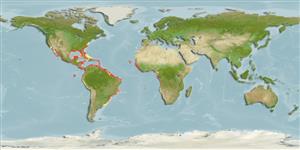
बेनथोपिलाजिक; गहराई सीमा 0 - 110 m (संदर्भ 101598), usually ? - 20 m (संदर्भ 435). Tropical; 39°N - 36°S, 121°W - 14°E
Atlantic Ocean and Eastern Pacific: from USA (New Jersey to south Florida) to Brazil (Amapa to Rio Grande do Sul), including central America, the Antilles, and northern South America; West Africa from Mauritania to Angola, including Cape Verde, Sao Tome and Principe, and Annobon Islands; Eastern Pacific from California, and Baja California to Peru, including Clipperton Island and Galagapos Islands. Temperate to tropical.
प्रथम परिपक्वता पर लंबाई / आकार / वज़न / आयु
परिपक्व अवधि: Lm ? range ? - ? cm Max length : 5.2 cm CL पुल्लिंग / अलिंग; (संदर्भ 435)
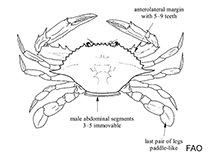
Carapace width range: 0.63 cm (Ref. 93549) to 8.2 cm (Ref. 435). Minimum depth from Ref. 104055. Benthopelagic (Ref. 97531). Occurs from the intertidal zone to a depth of 38 m, common at depths less than 20 m. Inhabits different kinds of bottom, usually covered with algae, ascidia, etc. (Ref 435). Found on sandy beaches, rocky areas as well as those with gravel (Ref. 104219). Also occurs in tide pools and rock rubble in sublittoral areas (Ref. 106321). In general, portunid crabs are reported to be mainly carnivorous (Ref. 72665).
जीवन चक्र और संभोग व्यवहार
परिपक्व अवधि | पुनरुत्पत्ति | मछलीऔ का अंडे देना | अंडे | उपजाऊपन | लार्वा
Members of the order Decapoda are mostly gonochoric. Mating behavior: Precopulatory courtship ritual is common (through olfactory and tactile cues); usually indirect sperm transfer.
Fischer, W., G. Bianchi and W.B. Scott (eds.) 1981 True Crabs. 6: pag.var. In FAO species identification sheets for fishery purposes. Eastern Central Atlantic (fishing areas 34, 47; in part). Canada Funds-in-Trust. Ottawa, Department of Fisheries and Oceans Canada, by arrangement with the Food and AgriculturesOrganization of the United Nations, 1-7: pag.var. (संदर्भ 435)
आईयूसीएन रेड लिस्ट स्थिति
(संदर्भ 130435: Version 2025-2 (Global))
CITES स्थिति (संदर्भ 108899)
Not Evaluated
CMS (संदर्भ 116361)
Not Evaluated
मनुष्यों के लिए ख़तरा
मानव उपयोग
FAO - Publication: search | FishSource |
साधन
अधिक जानकारी
ट्रॉफिक पारिस्थितिकीखाद्य पदार्थ (शिकार)संघटक आहारआहार खपतपरभक्षी जनसंख्या गतिशीलताबाढ़अधिकतम आयु/आकारलंबाई-वजन संबंधलंबाई-लंबाई संबंधलंबाई-आवृत्तियाँसामूहिक रूपांतरणबहुतायत फिजियोलॉजीप्राणवायु की खपत
मानव संबंधीटिकट, सिक्के, विविध.
इंटरनेट स्रोत
मॉडल पर आधारित अनुमान
मछली पकड़ने की भेद्यता
(संदर्भ 71543) |
Low vulnerability (10 of 100). |
मूल्य श्रेणी
(संदर्भ 80766): |
Unknown. |