Bivalvia |
Venerida |
Veneridae
Environment: milieu / climate zone / depth range / distribution range
Ecology
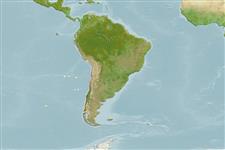
Benthic; depth range 0 - 20 m (Ref. 101272). Temperate, preferred 18°C (Ref. 107945); 16°S - 47°S, 110°W - 70°W
Southeast Pacific: Chile, Easter Island, and Peru. Subtropical to temperate.
Length at first maturity / Size / Weight / Age
Maturity: Lm ? range ? - ? cm Max length : 8.0 cm SHL male/unsexed; (Ref. 101426)
Common shell length is between 5 to 7 cm (Ref. 101426). Subtidal, living just below the surface of sandy substrates. Also found intertidally in mud and gravel (Ref. 116664). Has high lethal temperature threshold, surviving El Niño events (Ref. 105334). In general, suspension feeding bivalves mainly depend on phytoplankton and detritus material for nutrition (Ref. 107088).
Life cycle and mating behavior
Maturity | Reproduction | Spawning | Eggs | Fecundity | Larvae
Members of the class Bivalvia are mostly gonochoric, some are protandric hermaphrodites. Life cycle: Embryos develop into free-swimming trocophore larvae, succeeded by the bivalve veliger, resembling a miniature clam.
Urban, H.J. and B. Campos 1994 Population dynamics of the bivalves Gari solida, Semele solida and Protothaca thaca from a small bay in Chile at 36° S. Mar. Ecol. Prog. Ser. 115:93-102. (Ref. 75339)
IUCN Red List Status
(Ref. 130435: Version 2025-2 (Global))
CITES status (Ref. 108899)
Not Evaluated
Not Evaluated
Threat to humans
Human uses
Fisheries: commercial
FAO - Fisheries: species profile, landings search; Publication: search | FishSource | Sea Around Us
Tools
More information
Life cycleReproductionMaturityFecunditySpawningEggsEgg developmentLarvae PhysiologyOxygen consumption
Human RelatedStamps, coins, misc.
Internet sources
Estimates based on models
Resilience
(Ref. 69278): |
Medium, minimum population doubling time 1.4 - 4.4 years (K=0.17-0.25) |
Fishing Vulnerability
(Ref. 71543) |
Low to moderate vulnerability (35 of 100). |
Climate Vulnerability
(Ref. 125649) |
High vulnerability (59 of 100) |
Price category
(Ref. 80766): |
Medium. |
Nutrients
|
Calcium = 149 [71, 228] mg/100g; Iron = 8.53 [1.95, 15.11] mg/100g; Protein = 9.88 [8.64, 11.12] %; Omega3 = 0.313 [0.202, 0.423] g/100g; Selenium = 61 [50, 72] μg/100g; VitaminA = 0 μg/100g; Zinc = 2.04 [0.56, 3.51] mg/100g (wet weight); based on nutrient studies. |