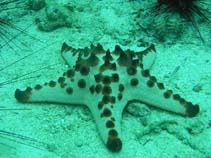
Asteroidea |
Valvatida |
Oreasteridae
محیط زیست: محیط زیست / منطقه آب و هوایی / تغييرات عمق / محدوده توزیع
بوم شناسي
وابسته به آب سنگ; تغييرات عمق 0 - 37 m (مرجع 89727). Tropical
Indo-West Pacific: from Seychelles to Australia and Japan.
طول در اولین بلوغ / اندازه / وزن / سن
بلوغ: Lm ? range ? - ? cm Max length : 30.0 cm WD جنس نر / بدون خواص جنسي; (مرجع 800)
It is known as a good bioindicator species for monitoring reef health (Ref. 85384) and has been harvested extensively as an ornament (Ref. 98606). Occurs on seagrass beds and seaweed areas (Refs. 82802, 89727), particularly on reef flats (Ref. 85384). It is known to be an extra-oral feeder (Ref. 85384) or microphagous feeder (Ref. 98606). Feeds on microbial and microalgal films, both living and decomposing seagrass blades, and filamentous green algae (Ref. 98606).
چرخه زندگی و رفتار جفتگیری
بلوغ | تولید مثل | تخم ریزی | تخم ها | باروری | توزاد ( لارو)
The embryo hatches into gastrula stage after 24 hours prior to fertilization; after 4-5 days, the larvae has reached the bipinnaria stage with well-developed mouth, esophagus and stomach; and at the 7th day, pre- and post-oral arms are visible (Ref. 98606).
مآخذ اصلی
مراجع | هماهنگ كننده | همكاران
Bos, A.R., G.S. Gumanao, J.C.E. Alipoyo and L.T. Cardona 2008 Population dynamics, reproduction and growth of Indo-Pacific horned star, Protoreaster nodosus (Echinodermata; Asteroidea). Marine Biology 156:55-63. (مرجع 89727)
وضعيت در فهرست قرمز IUCN
(مرجع 130435: Version 2025-2 (Global))
وضعيت از نظر سايتس (مرجع 108899)
Not Evaluated
Not Evaluated
خطر برای انسان ها
Harmless
استفاده انسانی
FAO - Publication: search | FishSource |
ابزارها
اطلاعات بيشتر
مرتبط با انسانتمبر، سکه، متفرقه.
منابع اينترنتي
تخمینها بر اساس مدلها
آسیبپذیری ماهیگیری
(مرجع 71543) |
Low vulnerability (20 of 100). |
طبقه قيمت
(مرجع 80766): |
Unknown. |