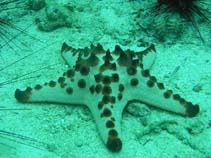
Asteroidea |
Valvatida |
Oreasteridae
Environnement : milieu / zone climatique / profondeur / gamme de distribution
Écologie
Récifal; profondeur 0 - 37 m (Réf. 89727). Tropical
Indo-West Pacific: from Seychelles to Australia and Japan.
Longueur à la première maturité / Taille / Poids / Âge
Maturité: Lm ? range ? - ? cm Max length : 30.0 cm WD mâle / non sexé; (Réf. 800)
It is known as a good bioindicator species for monitoring reef health (Ref. 85384) and has been harvested extensively as an ornament (Ref. 98606). Occurs on seagrass beds and seaweed areas (Refs. 82802, 89727), particularly on reef flats (Ref. 85384). It is known to be an extra-oral feeder (Ref. 85384) or microphagous feeder (Ref. 98606). Feeds on microbial and microalgal films, both living and decomposing seagrass blades, and filamentous green algae (Ref. 98606).
Cycle de vie et comportement reproducteur
Maturité | Reproduction | Frai | Œufs | Fécondité | Larves
The embryo hatches into gastrula stage after 24 hours prior to fertilization; after 4-5 days, the larvae has reached the bipinnaria stage with well-developed mouth, esophagus and stomach; and at the 7th day, pre- and post-oral arms are visible (Ref. 98606).
Bos, A.R., G.S. Gumanao, J.C.E. Alipoyo and L.T. Cardona 2008 Population dynamics, reproduction and growth of Indo-Pacific horned star, Protoreaster nodosus (Echinodermata; Asteroidea). Marine Biology 156:55-63. (Réf. 89727)
Statut dans la liste rouge de l'IUCN
(Réf. 130435: Version 2025-2 (Global))
statut CITES (Réf. 108899)
Not Evaluated
Not Evaluated
Menace pour l'homme
Harmless
Utilisations par l'homme
FAO - Publication: search | FishSource |
Outils
Plus d'informations
Dynamique des populations PhysiologieConsommation d'oxygène
Liées à l'hommeTimbres, pièces de monnaie, divers
Sources Internet
Estimations basées sur des modèles
Vulnérabilité de la pêche
(Réf. 71543) |
Low vulnerability (20 of 100). |
Catégorie de prix
(Réf. 80766): |
Unknown. |