Bivalvia |
Ostreida |
Ostreidae
Environnement : milieu / zone climatique / profondeur / gamme de distribution
Écologie
Benthic; saumâtre. Subtropical; 37°N - 17°N, 108°E - 134°E
Northwest Pacific: from Japan to South Korea, China and Taiwan.
Longueur à la première maturité / Taille / Poids / Âge
Maturité: Lm ? range ? - ? cm Max length : 6.0 cm SHL mâle / non sexé; (Réf. 101471)
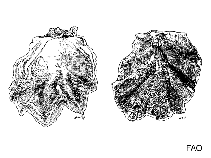
Studies show that in comparison to Crassostrea gigas, this species is slower in growth, and smaller size. Morphologically, its left valve is deeply cupped its shell is ridged or highly wrinkled. In its native range, mature eggs are produced in early winter, while in the US Pacific, it comes in late summer through early winter (Refs. 86666, 86667). It is also known to have a one-way gametic incompatibility barrier, which prohibits the sperm of this species to fertilize other species, i.e., Crassostrea gigas (Refs. 86666, 86668). Since 1947, this species has been imported to the US for experimental and commercial purposes (Ref. 86669). Its conservation status remains questionnable due to the lack of information on its distribution as well as the taxonomic confusion with Crassostrea gigas (Ref. 86665). This species is found in intertidal areas, particularly on hard substrates (Ref. 86665). Also occurs in a muddy flat (Ref. 106134) as well as in estuary in tidal flats (Ref. 106135). In general, suspension feeding bivalves mainly depend on phytoplankton and detritus material for nutrition (Ref. 107088).
Cycle de vie et comportement reproducteur
Maturité | Reproduction | Frai | Œufs | Fécondité | Larves
In its native range, mature eggs are produced in early winter, while in the US Pacific, it comes in late summer through early winter (Ref. 86666, 86667).
Camara, M. D., J.P. Davis, M. Sekino, D. Hedgecock, G. Li, C.J. Langdon and S. Evans 2008 The Kumamoto oyster Crassostrea sikamea is neither rare nor threatened by hybridization in the Northern Ariake sea, Japan. Journal of Shellfish Research 27(2):313-322. (Réf. 86665)
Statut dans la liste rouge de l'IUCN
(Réf. 130435: Version 2025-2 (Global))
statut CITES (Réf. 108899)
Not Evaluated
Not Evaluated
Menace pour l'homme
Harmless
Utilisations par l'homme
Pêcheries: commercial
FAO - Publication: search | FishSource | Sea Around Us
Outils
Plus d'informations
Dynamique des populationsCroissance
Âges / tailles maximales
Longueur-poids rel.
Rel. longueur-longueur.
Fréquences de longueurs
Conversion de masse
Abondance
Cycle de vieReproductionMaturitéFéconditéFraiŒufsDéveloppement de l'œufLarves PhysiologieConsommation d'oxygène
Liées à l'hommeTimbres, pièces de monnaie, divers
Sources Internet
Estimations basées sur des modèles
Vulnérabilité de la pêche
(Réf. 71543) |
Low vulnerability (10 of 100). |
Nutrients
|
Calcium = 149 [71, 228] mg/100g; Iron = 8.53 [1.95, 15.11] mg/100g; Protein = 9.88 [8.64, 11.12] %; Omega3 = 0.313 [0.202, 0.423] g/100g; Selenium = 61 [50, 72] μg/100g; VitaminA = 0 μg/100g; Zinc = 2.04 [0.56, 3.51] mg/100g (wet weight); based on nutrient studies. |