Bivalvia |
Ostreida |
Ostreidae
पर्यावरण: पर्यावरण / जलवायु क्षेत्र / गहराई सीमा / वितरण सीमा
पारिस्थितिकी
Benthic; खारा. Subtropical; 37°N - 17°N, 108°E - 134°E
Northwest Pacific: from Japan to South Korea, China and Taiwan.
प्रथम परिपक्वता पर लंबाई / आकार / वज़न / आयु
परिपक्व अवधि: Lm ? range ? - ? cm Max length : 6.0 cm SHL पुल्लिंग / अलिंग; (संदर्भ 101471)
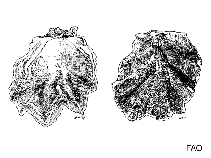
Studies show that in comparison to Crassostrea gigas, this species is slower in growth, and smaller size. Morphologically, its left valve is deeply cupped its shell is ridged or highly wrinkled. In its native range, mature eggs are produced in early winter, while in the US Pacific, it comes in late summer through early winter (Refs. 86666, 86667). It is also known to have a one-way gametic incompatibility barrier, which prohibits the sperm of this species to fertilize other species, i.e., Crassostrea gigas (Refs. 86666, 86668). Since 1947, this species has been imported to the US for experimental and commercial purposes (Ref. 86669). Its conservation status remains questionnable due to the lack of information on its distribution as well as the taxonomic confusion with Crassostrea gigas (Ref. 86665). This species is found in intertidal areas, particularly on hard substrates (Ref. 86665). Also occurs in a muddy flat (Ref. 106134) as well as in estuary in tidal flats (Ref. 106135). In general, suspension feeding bivalves mainly depend on phytoplankton and detritus material for nutrition (Ref. 107088).
जीवन चक्र और संभोग व्यवहार
परिपक्व अवधि | पुनरुत्पत्ति | मछलीऔ का अंडे देना | अंडे | उपजाऊपन | लार्वा
In its native range, mature eggs are produced in early winter, while in the US Pacific, it comes in late summer through early winter (Ref. 86666, 86667).
Camara, M. D., J.P. Davis, M. Sekino, D. Hedgecock, G. Li, C.J. Langdon and S. Evans 2008 The Kumamoto oyster Crassostrea sikamea is neither rare nor threatened by hybridization in the Northern Ariake sea, Japan. Journal of Shellfish Research 27(2):313-322. (संदर्भ 86665)
आईयूसीएन रेड लिस्ट स्थिति
(संदर्भ 130435: Version 2025-2 (Global))
CITES स्थिति (संदर्भ 108899)
Not Evaluated
CMS (संदर्भ 116361)
Not Evaluated
मनुष्यों के लिए ख़तरा
Harmless
मानव उपयोग
मात्स्यिकी: व्यापारिक
FAO - Publication: search | FishSource | हमारे चारों ओर समुद्र
साधन
अधिक जानकारी
जनसंख्या गतिशीलताबाढ़
अधिकतम आयु/आकार
लंबाई-वजन संबंध
लंबाई-लंबाई संबंध
लंबाई-आवृत्तियाँ
सामूहिक रूपांतरण
बहुतायत
जीवन चक्रपुनरुत्पत्तिपरिपक्व अवधिउपजाऊपनमछलीऔ का अंडे देनाअंडेअंडे का विकासलार्वा फिजियोलॉजीप्राणवायु की खपत
मानव संबंधीटिकट, सिक्के, विविध.
इंटरनेट स्रोत
मॉडल पर आधारित अनुमान
मछली पकड़ने की भेद्यता
(संदर्भ 71543) |
Low vulnerability (10 of 100). |
Nutrients
|
Calcium = 149 [71, 228] mg/100g; Iron = 8.53 [1.95, 15.11] mg/100g; Protein = 9.88 [8.64, 11.12] %; Omega3 = 0.313 [0.202, 0.423] g/100g; Selenium = 61 [50, 72] μg/100g; VitaminA = 0 μg/100g; Zinc = 2.04 [0.56, 3.51] mg/100g (wet weight); based on nutrient studies. |