Malacostraca |
Decapoda |
Palinuridae
Umwelt: Milieu / Klimazone / Tiefenbereich / Verbreitungsgebiet
Ökologie
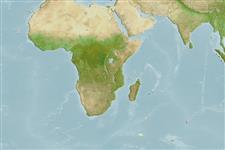
Benthic; tiefenbereich 0 - 200 m (Ref. 4), usually 10 - 40 m (Ref. 4). Temperate, preferred 15°C (Ref. 107945); 25°S - 47°S, 13°W - 99°E (Ref. 107486)
Southeast Atlantic, Western and Antarctic Indian Ocean.
Länge bei der ersten Reifung / Größe / Gewicht / Alter
Geschlechtsreife: Lm 6.3, range 6 - 7.5 cm Max length : 37.0 cm TL Männchen/unbestimmt; (Ref. 4); 27 cm TL (female); common length : 28.0 cm TL Männchen/unbestimmt; (Ref. 4); common length :21 cm TL (female)
The total body length of largest specimen ever recorded is 37 cm; and the total body length is 14 to 35.5 cm (male) and 9 to 27 cm (female); and carapace lengths of 6 to 14.5 cm (male) and 4 to 10 cm (female); with an average size of 21 to 28 cm (male) and 19 to 21 cm (female). The specimens from Amsterdam are slightly smaller than those from St Paul Island (Ref. 4). Occurs at depths of 0 to 200 m on rocky or gravel bottom, being most numerous in the kelp zone between 10 and 40 m (Ref. 4). Found clinging to overhangs in deep shade underneath huge rocks; also in caves (Ref. 106858). Confined to oceanic islands and seamounts (Ref. 105202). It is nocturnal and feeds on plants and dead animal matter (Ref. 4). Partially vegetarian (Ref. 105260). Reported to exhibit cannibalism among its deep-water populations (Ref. 105202).
Lebenszyklus und Paarungsverhalten
Geschlechtsreife | Fortpflanzung | Ablaichen | Eier | Fruchtbarkeit | Larven
May exhibit gynandromorphy (Ref. 10623). Egg-laying starts in May, and ovigerous females have been observed until November, or exceptionally early December. Females are caught from May to October, while males dominate in most catches from November to April (Ref. 4).
Holthuis, L.B. 1991 FAO Species Catalogue. Vol. 13. Marine lobsters of the world. An annotated and illustrated catalogue of species of interest to fisheries known to date. FAO Fish. Synop. 125(13):292p. Rome: FAO. (Ref. 4)
IUCN Rote Liste Status
(Ref. 130435: Version 2025-2 (Global))
CITES Status (Ref. 108899)
Not Evaluated
Not Evaluated
Bedrohung für Menschen
Nutzung durch Menschen
Fischereien: kommerziell
FAO - Fischereien: landings search; Publication: search | FishSource | Das Meer um uns herum
Tools
Mehr Information
PhysiologieSauerstoffverbrauch
MenschenbezogenBriefmarken, Münzen, Verschiedenes.
Internet Quellen
Schätzungen auf der Grundlage von Modellen
Widerstandsfähigkeit
(Ref. 69278): |
niedrig, Verdopplung der Population dauert 4,5 - 14 Jahre. (K=0.06-0.11) |
Anfälligkeit der Fischerei
(Ref. 71543) |
Moderate to high vulnerability (54 of 100). |
Klimaanfälligkeit
(Ref. 125649) |
High to very high vulnerability (74 of 100) |
Preiskategorie
(Ref. 80766): |
Very high. |
Nutrients
|
Calcium = 109 [35, 184] mg/100g; Iron = 1.59 [1.21, 1.97] mg/100g; Protein = 20.2 [19.2, 21.3] %; Omega3 = 0.285 [0.185, 0.386] g/100g; Selenium = 48.3 [-31.7, 128.3] μg/100g; VitaminA = 0 μg/100g; Zinc = 1.79 [1.17, 2.40] mg/100g (wet weight); based on nutrient studies. |