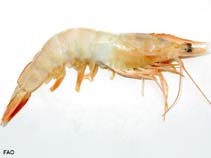
Malacostraca |
Decapoda |
Penaeidae
สิ่งแวดล้อม : สิ่งแวดล้อม / เขตภูมิอากาศ / ระดับความลึก / ระยะการกระจายสินค้า
นิเวศวิทยา
Benthic; กร่อย; ระดับความลึก 0 - 119 m (อ้างอิง 356). Subtropical, preferred 24°C (อ้างอิง 107945); 41°N - 18°N, 98°W - 73°W
Western Atlantic: from Tamaulipas and Yucatan, Mexico to Florida, north to New York, USA.
ความยาวเมื่อครบกำหนดครั้งแรก / ขนาด / น้ำหนัก / อายุ
วัยเจริญพันธุ์: Lm ?, range 17 - ? cm Max length : 22.4 cm TL เพศผู้/กระเทย; (อ้างอิง 109188); 20 cm TL (female); อายุสูงสุดที่ได้รายงาน: 2.00 ปี (อ้างอิง 109223)
Maximum total length of unsexed and female from Ref. 88'>109188 and Ref. 8, respectively. Maximum standard length: 19.0 cm. Maximum depth from Ref. 108758. Occurs at depths from 2 to 90 m in bottom mud or peat with sand or clay in marine (adults) and estuarine (juveniles) environments. Temperate to tropical climates (Ref. 8). Migrates to deeper areas within estuaries as it grows. Juveniles are also found across vegetated marsh edge, oyster reefs, and oyster shell deposits and non-vegetated bottom (Ref. 106898). Regularly uses vegetated intertidal marshes when the habitat is tidally inundated. Omnivore, feeds on live and dead plant and animal matter, including detritus (Ref. 67681) but also an epibenthic predator, feeding on small crustaceans, bivalves, polychaetes and oligochaetes (Ref. 108790).
Life cycle: Eggs hatch into planktonic nauplii. The larvae undergo five nauplial, three protozoeal, and three mysis stages; then into two postlarval stages (Refs. 254, 79469). Mating behavior: Precopulatory courtship ritual is common (through olfactory and tactile cues); usually indirect sperm transfer (Ref. 833). Copulation occurs when the male attached its spermatophore to the thelycum of the female (Ref. 109188). Spawning may occur once or up to four times (Ref. 109189).
Holthuis, L.B. 1980 FAO Species Catalogue. Vol. 1. Shrimps and prawns of the world. An annotated catalogue of species of interest to fisheries. FAO Fish. Synop. 125(1):271 p. Rome: FAO. (อ้างอิง 8)
สถานะบัญชีแดงของ IUCN
(อ้างอิง 130435: Version 2025-2 (Global))
สถานะไซเตส (อ้างอิง 108899)
Not Evaluated
CMS (อ้างอิง 116361)
Not Evaluated
ภัยคุกคามต่อมนุษย์
การใช้ของมนุษย์
การประมง: การค้า; การเพาะเลี้ยงสัตว์น้ำ: การทดลอง
FAO - Aquaculture Systems: production searchการประมง: โปรไฟล์สายพันธุ์, landings search; Publication: search | FishSource | ทะเลรอบๆเรา
เครื่องมือ
ข้อมูลเพิ่มเติม
เกี่ยวข้องกับมนุษย์แสตมป์ เหรียญ อื่นๆ
แหล่งที่มาจากอินเตอร์เน็ต
การประมาณค่าตามแบบจำลอง
ความสามารถในการกลับคืนสู่ปกติ
(Ref. 69278): |
ความสูง, เวลาต่ำสุดที่จะทำให้ประชากรเพิ่มขึ้นเป็น 2 เท่าใช้เวลาน้อยกว่า 15 เดือน (K=1.25-9.8; tmax=2) |
Rate of population increase
|
Prior r = 0.53, 95% CL = 0.35 - 0.80, Based on 2 full stock assessments. |
ความเสี่ยงต่อการตกปลา
(อ้างอิง 71543) |
Low vulnerability (11 of 100). |
ความเสี่ยงต่อสภาพภูมิอากาศ
(อ้างอิง 125649) |
High vulnerability (62 of 100) |
หมวดหมู่ราคา
(อ้างอิง 80766): |
Very high. |
Nutrients
|
Calcium = 109 [35, 184] mg/100g; Iron = 1.59 [1.21, 1.97] mg/100g; Protein = 20.2 [19.2, 21.3] %; Omega3 = 0.285 [0.185, 0.386] g/100g; Selenium = 48.3 [-31.7, 128.3] μg/100g; VitaminA = 0 μg/100g; Zinc = 1.79 [1.17, 2.40] mg/100g (wet weight); based on nutrient studies. |