Malacostraca |
Decapoda |
Upogebiidae
Environnement : milieu / zone climatique / profondeur / gamme de distribution
Écologie
Benthic; saumâtre. Subtropical; 48°N - 30°N, 117°E - 153°E (Réf. 4)
Northwest Pacific: S.E. coast of Siberia, USSR, from Olga Bay southward, Korea, N. China, Kuril Islands, Japan.
Longueur à la première maturité / Taille / Poids / Âge
Maturité: Lm ? range ? - ? cm Max length : 9.5 cm BL mâle / non sexé; (Réf. 4)
Description synthétique
Morphologie
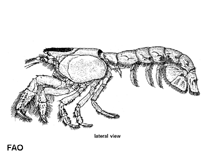
Rostrum ending in 3 teeth, the lateral at the end of a ridge that is separated from the central part of the rostrum by a deep groove; a shallow median longitudinal groove is present in the central part. The lower surface of the rostrum has no spines. Anterolateral border of carapace with a single spine at the level of the eye. First pereiopods subchelate. Dactylus of adult male with 9 to 11 oblique ridges on the outer surface, and with a low tooth in the proximal half of the cutting edge. Two denticulate ridges on the upper surface of the palm. Merus of the first pereiopod with a distinct subdistal anterodorsal spine; coxa of that leg with a spine (Ref. 4).
It has a maximum total body length of 9.5 cm (Ref. 4). It is found in tidal mud flats and it makes Y-shaped burrows in the mud and are filter feeders (Ref. 4).
Cycle de vie et comportement reproducteur
Maturité | Reproduction | Frai | Œufs | Fécondité | Larves
Members of the order Decapoda are mostly gonochoric. Mating behavior: Precopulatory courtship ritual is common (through olfactory and tactile cues); usually indirect sperm transfer.
Holthuis, L.B. 1991 FAO Species Catalogue. Vol. 13. Marine lobsters of the world. An annotated and illustrated catalogue of species of interest to fisheries known to date. FAO Fish. Synop. 125(13):292p. Rome: FAO. (Réf. 4)
Statut dans la liste rouge de l'IUCN
(Réf. 130435: Version 2025-2 (Global))
statut CITES (Réf. 108899)
Not Evaluated
Not Evaluated
Menace pour l'homme
Utilisations par l'homme
Pêcheries: commercial
FAO - Publication: search | FishSource |
Outils
Plus d'informations
Écologie trophiqueAliments (proies)Composition du régime alimentaireConsommation alimentairePrédateurs Dynamique des populationsCroissanceÂges / tailles maximalesLongueur-poids rel.Rel. longueur-longueur.Fréquences de longueursConversion de masseAbondance Cycle de vieReproductionMaturitéFéconditéFraiŒufsDéveloppement de l'œufLarves PhysiologieConsommation d'oxygène
Liées à l'hommeTimbres, pièces de monnaie, divers
Sources Internet
Estimations basées sur des modèles
Vulnérabilité de la pêche
(Réf. 71543) |
Low vulnerability (23 of 100). |
Catégorie de prix
(Réf. 80766): |
Unknown. |