Malacostraca |
Decapoda |
Upogebiidae
Umwelt: Milieu / Klimazone / Tiefenbereich / Verbreitungsgebiet
Ökologie
Benthic; brackwasser. Subtropical; 48°N - 30°N, 117°E - 153°E (Ref. 4)
Northwest Pacific: S.E. coast of Siberia, USSR, from Olga Bay southward, Korea, N. China, Kuril Islands, Japan.
Länge bei der ersten Reifung / Größe / Gewicht / Alter
Geschlechtsreife: Lm ? range ? - ? cm Max length : 9.5 cm BL Männchen/unbestimmt; (Ref. 4)
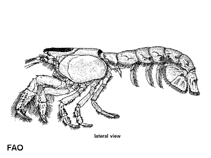
Rostrum ending in 3 teeth, the lateral at the end of a ridge that is separated from the central part of the rostrum by a deep groove; a shallow median longitudinal groove is present in the central part. The lower surface of the rostrum has no spines. Anterolateral border of carapace with a single spine at the level of the eye. First pereiopods subchelate. Dactylus of adult male with 9 to 11 oblique ridges on the outer surface, and with a low tooth in the proximal half of the cutting edge. Two denticulate ridges on the upper surface of the palm. Merus of the first pereiopod with a distinct subdistal anterodorsal spine; coxa of that leg with a spine (Ref. 4).
It has a maximum total body length of 9.5 cm (Ref. 4). It is found in tidal mud flats and it makes Y-shaped burrows in the mud and are filter feeders (Ref. 4).
Lebenszyklus und Paarungsverhalten
Geschlechtsreife | Fortpflanzung | Ablaichen | Eier | Fruchtbarkeit | Larven
Members of the order Decapoda are mostly gonochoric. Mating behavior: Precopulatory courtship ritual is common (through olfactory and tactile cues); usually indirect sperm transfer.
Holthuis, L.B. 1991 FAO Species Catalogue. Vol. 13. Marine lobsters of the world. An annotated and illustrated catalogue of species of interest to fisheries known to date. FAO Fish. Synop. 125(13):292p. Rome: FAO. (Ref. 4)
IUCN Rote Liste Status
(Ref. 130435: Version 2025-2 (Global))
CITES Status (Ref. 108899)
Not Evaluated
Not Evaluated
Bedrohung für Menschen
Nutzung durch Menschen
Fischereien: kommerziell
FAO - Publication: search | FishSource |
Tools
Mehr Information
Trophische ÖkologieLebensmittel (Beutetiere)NahrungszusammensetzungNahrungsaufnahmeRäuber PopulationsdynamikWachstumMax. Alter/GrößenLänge-Gewicht-Rel.Länge-Länge-Verhältnis.LängenhäufigkeitenMassenkonvertierungDichte LebenszyklusFortpflanzungGeschlechtsreifeFruchtbarkeitAblaichenEierEientwicklungLarven PhysiologieSauerstoffverbrauch
MenschenbezogenBriefmarken, Münzen, Verschiedenes.
Internet Quellen
Schätzungen auf der Grundlage von Modellen
Anfälligkeit der Fischerei
(Ref. 71543) |
Low vulnerability (23 of 100). |
Preiskategorie
(Ref. 80766): |
Unknown. |