Malacostraca |
Decapoda |
Majidae
محیط زیست: محیط زیست / منطقه آب و هوایی / تغييرات عمق / محدوده توزیع
بوم شناسي
Benthic; تغييرات عمق 0 - 80 m (مرجع 104052). Temperate
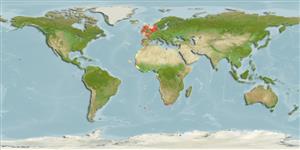
Eastern Atlantic and the Mediterranean: from the North Sea to Morocco and Bay of Biscay, extending southwards to Namibia including off lying islands.
طول در اولین بلوغ / اندازه / وزن / سن
بلوغ: Lm 13.0 range ? - ? cm Max length : 22.0 cm CL جنس نر / بدون خواص جنسي; (مرجع 104052)
Maximum depth from Ref. 115714. Juveniles about to reach maturity live in shallow waters from 10 to 15 m deep on rocky and sandy substrates (Ref. 115713). They are also found on sandy bottoms colonized by Zostera marina. During summer, adults live near the shore on rocky areas. In winter, they are spotted on rocky bottoms and heterogeneous coarse sediments in deep waters. Both juveniles and adults during summer are found on muddy sands with few rocks (Ref. 115714). Uses slow, small-scale, non-directional movements. Exhibiting ontogenetic movements, juveniles live at depth of 5 to 15 m; adults then migrate to deeper waters (>50 m), where they mate (Ref. 115713). Diet remains to be accurately described. Studies (i.e. direct field observations, laboratory experiments, and gut content analyses) have suggested the species to have an omnivorous diet based on consumption of prey commonly found in their habitat (Ref. 115714). In one study, however, it was considered a mobile carnivorous species (Ref. 96498). Research using stable isotopes indicate no differences between sexes in diet or habitat use patterns either in adults (Refs. 115714, 115744) or juveniles (Refs. 115713, 115714, 115744).
چرخه زندگی و رفتار جفتگیری
بلوغ | تولید مثل | تخم ریزی | تخم ها | باروری | توزاد ( لارو)
Members of the order Decapoda are mostly gonochoric. Mating behavior: Precopulatory courtship ritual is common (through olfactory and tactile cues); usually indirect sperm transfer.
مآخذ اصلی
مراجع | هماهنگ كننده | همكاران
Le Pape, O., L. Baulier, A. Cloarec, J. Martin, F. Le Loc'h and Y. Désaunay 2007 Habitat suitability for juvenile common sole (Solea solea, L.) in the Bay of Biscay (France): a quantitative description using indicators based on epibenthic fauna. Journal of Sea Research 57:126-136. (مرجع 96498)
وضعيت در فهرست قرمز IUCN
(مرجع 130435: Version 2025-2 (Global))
وضعيت از نظر سايتس (مرجع 108899)
Not Evaluated
Not Evaluated
خطر برای انسان ها
Harmless
استفاده انسانی
ماهي گيري – شيلات: تجاري
FAO - Publication: search | FishSource |
ابزارها
اطلاعات بيشتر
مرتبط با انسانتمبر، سکه، متفرقه.
منابع اينترنتي
تخمینها بر اساس مدلها
جهندگی
(Ref. 69278): |
زياد, كمينه زمان لازم براي دو برابر شدن جمعيت ، كمتر از 15 ماه (Fec=300,000) |
آسیبپذیری ماهیگیری
(مرجع 71543) |
Low vulnerability (12 of 100). |