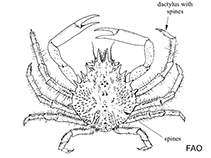
Malacostraca |
Decapoda |
Majidae
Environnement : milieu / zone climatique / profondeur / gamme de distribution
Écologie
Benthic; profondeur 0 - 80 m (Réf. 104052). Temperate
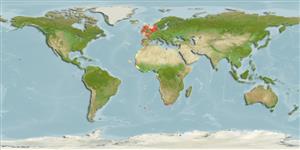
Eastern Atlantic and the Mediterranean: from the North Sea to Morocco and Bay of Biscay, extending southwards to Namibia including off lying islands.
Longueur à la première maturité / Taille / Poids / Âge
Maturité: Lm 13.0 range ? - ? cm Max length : 22.0 cm CL mâle / non sexé; (Réf. 104052)
Maximum depth from Ref. 115714. Juveniles about to reach maturity live in shallow waters from 10 to 15 m deep on rocky and sandy substrates (Ref. 115713). They are also found on sandy bottoms colonized by Zostera marina. During summer, adults live near the shore on rocky areas. In winter, they are spotted on rocky bottoms and heterogeneous coarse sediments in deep waters. Both juveniles and adults during summer are found on muddy sands with few rocks (Ref. 115714). Uses slow, small-scale, non-directional movements. Exhibiting ontogenetic movements, juveniles live at depth of 5 to 15 m; adults then migrate to deeper waters (>50 m), where they mate (Ref. 115713). Diet remains to be accurately described. Studies (i.e. direct field observations, laboratory experiments, and gut content analyses) have suggested the species to have an omnivorous diet based on consumption of prey commonly found in their habitat (Ref. 115714). In one study, however, it was considered a mobile carnivorous species (Ref. 96498). Research using stable isotopes indicate no differences between sexes in diet or habitat use patterns either in adults (Refs. 115714, 115744) or juveniles (Refs. 115713, 115714, 115744).
Cycle de vie et comportement reproducteur
Maturité | Reproduction | Frai | Œufs | Fécondité | Larves
Members of the order Decapoda are mostly gonochoric. Mating behavior: Precopulatory courtship ritual is common (through olfactory and tactile cues); usually indirect sperm transfer.
Le Pape, O., L. Baulier, A. Cloarec, J. Martin, F. Le Loc'h and Y. Désaunay 2007 Habitat suitability for juvenile common sole (Solea solea, L.) in the Bay of Biscay (France): a quantitative description using indicators based on epibenthic fauna. Journal of Sea Research 57:126-136. (Réf. 96498)
Statut dans la liste rouge de l'IUCN
(Réf. 130435: Version 2025-2 (Global))
statut CITES (Réf. 108899)
Not Evaluated
Not Evaluated
Menace pour l'homme
Harmless
Utilisations par l'homme
Pêcheries: commercial
FAO - Publication: search | FishSource |
Outils
Plus d'informations
Dynamique des populationsCroissanceÂges / tailles maximalesLongueur-poids rel.Rel. longueur-longueur.Fréquences de longueursConversion de masseAbondance PhysiologieConsommation d'oxygène
Liées à l'hommeTimbres, pièces de monnaie, divers
Sources Internet
Estimations basées sur des modèles
Résilience
(Ref. 69278): |
Haut, temps minimum de doublement de population inférieur à 15 mois (Fec=300,000) |
Vulnérabilité de la pêche
(Réf. 71543) |
Low vulnerability (12 of 100). |