Malacostraca |
Decapoda |
Eriphiidae
Umwelt: Milieu / Klimazone / Tiefenbereich / Verbreitungsgebiet
Ökologie
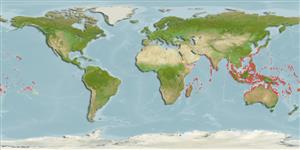
Riff-verbunden; tiefenbereich 0 - 6 m (Ref. 96667). Tropical; 36°N - 33°S, 29°E - 134°W
Indo-Pacific: north from Japan, China, Taiwan to southeast Asia, west to Australia, Christmas Island, Cocos (Keeling) Islands to India, Oman and east Africa.
Länge bei der ersten Reifung / Größe / Gewicht / Alter
Geschlechtsreife: Lm ? range ? - ? cm Max length : 8.0 cm CW Männchen/unbestimmt; (Ref. 343)
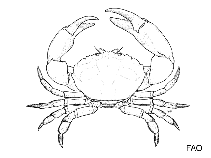
Carapace is oval in shape which is covered with tubercles. The frontal margin has six or more spines. Pair of pincers are unequal in size and are covered with very tiny granules (Ref. 128968).
Adults are found in rock cracks in shallow waters. They display aggressive and nocturnal behaviour (Ref. 128968). Collected for food. Occasionally mildly poisonous in some parts of its range. Mildly poisonous (Ref. 79155). Inhabits rocky shore or reefs. Benthic. Subtropical and tropical climates (Ref. 343). Intertidal (Ref. 106854). Also occurs on algal mat (Ref. 106227). Found within crevices in rocks or coral reefs (Ref. 79155). Observed on mangrove trees (Ref. 74547). Has large master claws with molariform teeth used to crush shells of snails and hermit crabs (Ref. 107019). Observed to open large Turbo sp. Shells in order to extract the terrestrial hermit crab Coenobita perlatus (Ref. 76500).
Lebenszyklus und Paarungsverhalten
Geschlechtsreife | Fortpflanzung | Ablaichen | Eier | Fruchtbarkeit | Larven
Members of the order Decapoda are mostly gonochoric. Mating behavior: Precopulatory courtship ritual is common (through olfactory and tactile cues); usually indirect sperm transfer.
Ng, P.K.L. 1998 Crabs. p. 1045-1155. In K.E. Carpenter and V.H. Niem (eds) FAO species identification guide for fishery purposes. The living marine resources of the Western Central Pacific. Volume 2. Cephalopods, crustaceans, holothurians and sharks. Rome, FAO. 1998. pp. 687-1396. (Ref. 343)
IUCN Rote Liste Status
(Ref. 130435: Version 2025-2 (Global))
CITES Status (Ref. 108899)
Not Evaluated
Not Evaluated
Bedrohung für Menschen
Poisonous to eat (Ref. 128968)
Nutzung durch Menschen
Fischereien: kommerziell
FAO - Publication: search | FishSource | Das Meer um uns herum
Tools
Mehr Information
PopulationsdynamikWachstumMax. Alter/GrößenLänge-Gewicht-Rel.Länge-Länge-Verhältnis.LängenhäufigkeitenMassenkonvertierungDichte LebenszyklusFortpflanzungGeschlechtsreifeFruchtbarkeitAblaichenEierEientwicklungLarven PhysiologieSauerstoffverbrauch
MenschenbezogenBriefmarken, Münzen, Verschiedenes.
Internet Quellen
Schätzungen auf der Grundlage von Modellen
Widerstandsfähigkeit
(Ref. 69278): |
hoch, Verdopplung der Population dauert weniger als 15 Monate. (K=0.68) |
Anfälligkeit der Fischerei
(Ref. 71543) |
Low vulnerability (17 of 100). |
Preiskategorie
(Ref. 80766): |
Unknown. |
Nutrients
|
Calcium = 109 [35, 184] mg/100g; Iron = 1.59 [1.21, 1.97] mg/100g; Protein = 20.2 [19.2, 21.3] %; Omega3 = 0.285 [0.185, 0.386] g/100g; Selenium = 48.3 [-31.7, 128.3] μg/100g; VitaminA = 0 μg/100g; Zinc = 1.79 [1.17, 2.40] mg/100g (wet weight); based on nutrient studies. |