Malacostraca |
Decapoda |
Eriphiidae
Môi trường: môi trường / vùng khí hậu / Mức độ sâu / phạm vi phân phối
Sinh thái học
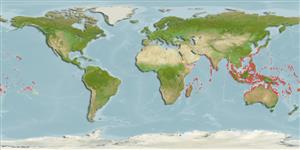
Cùng sống ở rạn san hô; mức độ sâu 0 - 6 m (Tài liệu tham khảo 96667). Tropical; 36°N - 33°S, 29°E - 134°W
Indo-Pacific: north from Japan, China, Taiwan to southeast Asia, west to Australia, Christmas Island, Cocos (Keeling) Islands to India, Oman and east Africa.
Chiều dài lúc trưởng thành đầu tiên / Bộ gần gũi / Khối lượng (Trọng lượng) / Tuổi
Chín muồi sinh dục: Lm ? range ? - ? cm Max length : 8.0 cm CW con đực/không giới tính; (Tài liệu tham khảo 343)
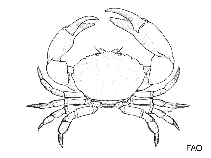
Carapace is oval in shape which is covered with tubercles. The frontal margin has six or more spines. Pair of pincers are unequal in size and are covered with very tiny granules (Ref. 128968).
Adults are found in rock cracks in shallow waters. They display aggressive and nocturnal behaviour (Ref. 128968). Collected for food. Occasionally mildly poisonous in some parts of its range. Mildly poisonous (Ref. 79155). Inhabits rocky shore or reefs. Benthic. Subtropical and tropical climates (Ref. 343). Intertidal (Ref. 106854). Also occurs on algal mat (Ref. 106227). Found within crevices in rocks or coral reefs (Ref. 79155). Observed on mangrove trees (Ref. 74547). Has large master claws with molariform teeth used to crush shells of snails and hermit crabs (Ref. 107019). Observed to open large Turbo sp. Shells in order to extract the terrestrial hermit crab Coenobita perlatus (Ref. 76500).
Vòng đời và hành vi giao phối
Chín muồi sinh dục | Sự tái sinh sản | Đẻ trứng | Các trứng | Sự sinh sản | Ấu trùng
Members of the order Decapoda are mostly gonochoric. Mating behavior: Precopulatory courtship ritual is common (through olfactory and tactile cues); usually indirect sperm transfer.
Ng, P.K.L. 1998 Crabs. p. 1045-1155. In K.E. Carpenter and V.H. Niem (eds) FAO species identification guide for fishery purposes. The living marine resources of the Western Central Pacific. Volume 2. Cephalopods, crustaceans, holothurians and sharks. Rome, FAO. 1998. pp. 687-1396. (Tài liệu tham khảo 343)
Tình trạng Sách đỏ IUCN
(Tài liệu tham khảo 130435: Version 2025-2 (Global))
tình trạng CITES (Tài liệu tham khảo 108899)
Not Evaluated
CMS (Tài liệu tham khảo 116361)
Not Evaluated
Mối đe dọa đối với con người
Poisonous to eat (Tài liệu tham khảo 128968)
Sử dụng của con người
Các nghề cá: tính thương mại
FAO - Publication: search | FishSource | Biển chung quanh ta
Các công cụ
Thêm thông tin
Biến động dân sốSự sinh trưởngĐộ tuổi / kích thước tối đaChiều dài-trọng lượng tương đốiChiều dài-chiều dài tương đối.Chiều dài-tần sốChuyển đổi khối lượngSự phong phú Vòng đờiSự tái sinh sảnChín muồi sinh dụcSự sinh sảnĐẻ trứngCác trứngSự phát triển của trứngẤu trùng Sinh lý họcThành phần ô-xy
Liên quan đến con ngườiTem, tiền xu, v.v.
Các nguồn internet
Ước tính dựa trên mô hình
Thích nghi nhanh
(Ref. 69278): |
Chiêù cao, thời gian nhân đôi của chủng quần tối thiểu là dưới 15 tháng (K=0.68) |
Sự dễ bị tổn thương của nghề đánh cá
(Tài liệu tham khảo 71543) |
Low vulnerability (17 of 100). |
Loại giá
(Tài liệu tham khảo 80766): |
Unknown. |
Nutrients
|
Calcium = 109 [35, 184] mg/100g; Iron = 1.59 [1.21, 1.97] mg/100g; Protein = 20.2 [19.2, 21.3] %; Omega3 = 0.285 [0.185, 0.386] g/100g; Selenium = 48.3 [-31.7, 128.3] μg/100g; VitaminA = 0 μg/100g; Zinc = 1.79 [1.17, 2.40] mg/100g (wet weight); based on nutrient studies. |