Malacostraca |
Isopoda |
Cirolanidae
Environnement : milieu / zone climatique / profondeur / gamme de distribution
Écologie
Bathydémersal; profondeur 310 - 2300 m (Réf. 3113), usually 365 - 730 m (Réf. 80749). Deep-water
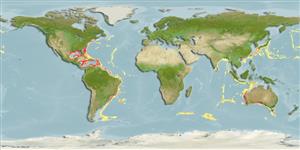
Indo-West Pacific and Western Atlantic.
Longueur à la première maturité / Taille / Poids / Âge
Maturité: Lm 18.0 range ? - ? cm Max length : 50.0 cm TL mâle / non sexé; (Réf. 99323)
Description synthétique
Morphologie
Body depressed without distinct carapace. First thoracic segment fused with head. Sessible eyes; uniramous antennules with reduced exopodites.. First pair of thoracic appendages specialized as maxilliped; other thoracic appendages without exopodites. Shortened abdomen with segments often fused into caudal shield. Pleopods biramous, with flat rami serving as gills. Uropods and telson form fan-like fin, legs natatory.
Largest known isopod. Inhabits the upper and mid slopes of the continental shelf. Bycatch of baited traps (Ref. 80748). This species has mouthparts which are highly adapted to cut and ingest large pieces of food, a large and distensible gut for maximum food ingestion as well as the capacity to store large amounts of lipids in the hepatopancreas (Ref. 80748). Maximum depth range from Ref. 111151. Believed to be a scavenger because of its high incidence in bycatch of trap fisheries (e.g., golden crab, Chaceon fenneri, trap fishery in Northern Gulf of Mexico; see Ref. 80748) (Ref. 3113).
Cycle de vie et comportement reproducteur
Maturité | Reproduction | Frai | Œufs | Fécondité | Larves
Oviposition in females preceded by parturial molt; functional form of oostegites obtained; females can grow between 1-3 cm BL in first parturial molt; 1 or more pre-parturial molts between the onset of ovarian maturity and first parturial molt.
Schotte, M., B.F. Kensley and S. Shilling 1995 World list of marine, freshwater and terrestrial crustacea isopoda. National Museum of Natural History Smithsonian Institution: Washington D.C., USA. Http://www.nmnh.si.edu/iz/isopod/ [Accessed 07/03/01]. (Réf. 3113)
Statut dans la liste rouge de l'IUCN
(Réf. 130435: Version 2025-2 (Global))
statut CITES (Réf. 108899)
Not Evaluated
Not Evaluated
Menace pour l'homme
Utilisations par l'homme
Pêcheries: sans intérêt
FAO - Publication: search | FishSource |
Outils
Plus d'informations
Dynamique des populations PhysiologieConsommation d'oxygène
Liées à l'hommeTimbres, pièces de monnaie, divers
Sources Internet
Estimations basées sur des modèles
Résilience
(Ref. 69278): |
Haut, temps minimum de doublement de population inférieur à 15 mois (K=0.74) |
Vulnérabilité de la pêche
(Réf. 71543) |
Low to moderate vulnerability (27 of 100). |
Catégorie de prix
(Réf. 80766): |
Unknown. |