Malacostraca |
Decapoda |
Grapsidae
Milieu: milieu / Klimaatzone / Diepte / verspreidingsgebied
Ecologie
Benthic; brak water; diepte 0 - 2 m (Ref. 101599). Tropical; 33°N - 30°S, 98°W - 14°E
Atlantic Ocean: from Florida to Bermuda, Mexico, Belize, Panama, the Antilles, Colombia, Venezuela, the Guianas, to Brazil (Para to Santa Catarina, including Fernando de Noronha), and the eastern Atlantic, from Senegal to Angola.
Lengte bij maturiteit / Grootte / Gewicht / Leeftijd
Maturiteit: Lm 2.5, range 2 - 2.9 cm Max length : 5.6 cm CW mannelijk / geslacht onbekend; (Ref. 102095); 5.1 cm CW (female)
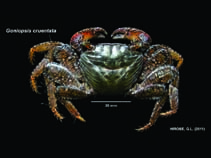
Inhabits brackish muddy waters, often in mangrove swamps (Ref. 435), able to move fast between the roots and trunks of trees (Ref. 104080). Found in burrows (Ref. 86356), from intertidal to supratidal waters (Ref. 97531). Excellent predator in the mangroves (Ref. 104080). Feeds on mangrove propagules and animal matter (Ref. 86356). First marine crab reported to feed on an amphibian Leptodactylus macrosternum, wherein the frog was found near the crab's burrow (Ref. 104080).
Fischer, W., G. Bianchi and W.B. Scott (eds.) 1981 True Crabs. 6: pag.var. In FAO species identification sheets for fishery purposes. Eastern Central Atlantic (fishing areas 34, 47; in part). Canada Funds-in-Trust. Ottawa, Department of Fisheries and Oceans Canada, by arrangement with the Food and AgriculturesOrganization of the United Nations, 1-7: pag.var. (Ref. 435)
Status op de Rode Lijst van het IUCN
(Ref. 130435: Version 2025-2 (Global))
CITES status (Ref. 108899)
Not Evaluated
Not Evaluated
Gevaar voor de mens
Gebruik door de mens
Visserij: commercieel
FAO - Publication: search | FishSource |
Tools
Meer informatie
FysiologieZuurstofverbruik
Menselijk gerelateerdPostzegels, munten, diversen.
Internetbronnen
Schattingen op basis van modellen
Weerstandsvermogen
(Ref. 69278): |
Hoog, minimale populatieverdubbelingstijd minder dan 15 maanden (K=2.24-2.5; tm=0.23) |
Kwetsbaarheid van de visserij
(Ref. 71543) |
Low vulnerability (10 of 100). |
Prijsklasse
(Ref. 80766): |
Unknown. |