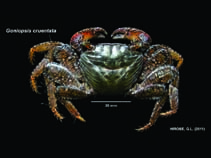
Malacostraca |
Decapoda |
Grapsidae
Environnement : milieu / zone climatique / profondeur / gamme de distribution
Écologie
Benthic; saumâtre; profondeur 0 - 2 m (Réf. 101599). Tropical; 33°N - 30°S, 98°W - 14°E
Atlantic Ocean: from Florida to Bermuda, Mexico, Belize, Panama, the Antilles, Colombia, Venezuela, the Guianas, to Brazil (Para to Santa Catarina, including Fernando de Noronha), and the eastern Atlantic, from Senegal to Angola.
Longueur à la première maturité / Taille / Poids / Âge
Maturité: Lm 2.5, range 2 - 2.9 cm Max length : 5.6 cm CW mâle / non sexé; (Réf. 102095); 5.1 cm CW (female)
Inhabits brackish muddy waters, often in mangrove swamps (Ref. 435), able to move fast between the roots and trunks of trees (Ref. 104080). Found in burrows (Ref. 86356), from intertidal to supratidal waters (Ref. 97531). Excellent predator in the mangroves (Ref. 104080). Feeds on mangrove propagules and animal matter (Ref. 86356). First marine crab reported to feed on an amphibian Leptodactylus macrosternum, wherein the frog was found near the crab's burrow (Ref. 104080).
Cycle de vie et comportement reproducteur
Maturité | Reproduction | Frai | Œufs | Fécondité | Larves
Fischer, W., G. Bianchi and W.B. Scott (eds.) 1981 True Crabs. 6: pag.var. In FAO species identification sheets for fishery purposes. Eastern Central Atlantic (fishing areas 34, 47; in part). Canada Funds-in-Trust. Ottawa, Department of Fisheries and Oceans Canada, by arrangement with the Food and AgriculturesOrganization of the United Nations, 1-7: pag.var. (Réf. 435)
Statut dans la liste rouge de l'IUCN
(Réf. 130435: Version 2025-2 (Global))
statut CITES (Réf. 108899)
Not Evaluated
Not Evaluated
Menace pour l'homme
Utilisations par l'homme
Pêcheries: commercial
FAO - Publication: search | FishSource |
Outils
Plus d'informations
Dynamique des populations PhysiologieConsommation d'oxygène
Liées à l'hommeTimbres, pièces de monnaie, divers
Sources Internet
Estimations basées sur des modèles
Résilience
(Ref. 69278): |
Haut, temps minimum de doublement de population inférieur à 15 mois (K=2.24-2.5; tm=0.23) |
Vulnérabilité de la pêche
(Réf. 71543) |
Low vulnerability (10 of 100). |
Catégorie de prix
(Réf. 80766): |
Unknown. |