Malacostraca |
Stomatopoda |
Squillidae
Miljö: miljö / Klimatzon / djupintervall / distributionsområde
Ekologi
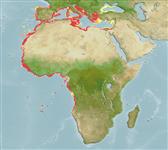
Benthic; djupintervall 0 - 367 m (Ref. 365), usually 50 - 120 m (Ref. 436). Subtropical, preferred 20°C (Ref. 107945); 46°N - 17°S, 18°W - 36°E
Eastern Atlantic from Gulf of Cadiz, Canary, Madeira Island and south to Angola, and the Mediterranean Sea.
Längd vid första mognad / Storlek / Vikt / Ålder
Könsmognad: Lm 8.7, range 2 - 2.4 cm Max length : 20.0 cm TL hane/ej könsbestämd; (Ref. 365)
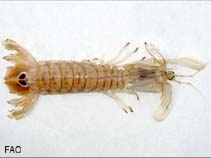
Stomatopod of average size; Maximum: 20 cm; common of 12 to 18 cm. Body: with very marked peaks, peaks sub median of the 5th abdominal segment with posterior spines; process lateral of the 5th thoracic segment ending in only one tooth very pointed and bent forwards. Dorsal face of the telson: with a median peak marked well and many small depressions, but deprived of lines of tubers. Dactyl of the leg: kidnapper armed with 6 spines, its regularly convex external edge. Coloring: yellowish or brownish; often reddish or bluish peaks. A dark line extends along the posterior edge from the thoracic segments, 6 to 8 and the abdominal segments, 1 to 5; a median rectangular spot sinks on the second abdominal segment; telson marked of yellow and with 2 spots dark chestnut surrounded of a white ring (Ref. 363).
Importance: Semi-industrial, artisanal and sporting fishing with basic trawls, trémails, bow nets, dredgers and seines of beach. Maximum depth from Ref. 93636. Benthic, strongly related to bottom sediments (Ref. 93636). Demersal above muddy bottoms (Ref. 365). Found from littoral to sublittoral depths on sandy, muddy, silty sand and sandy mud bottoms. Strongly sedentary. Burrows especially in areas with suitable burrowing substrates like fine sand and sandy mud exist. Highly territorial (Ref. 93636).
Males produce sperm ducts rather than spermatophores; females can brood a maximum of 50,000 eggs (Ref. 833). Life cycle: Females incubate eggs in burrows (Ref. 108993). Eggs hatch to planktonic zoea which lasts for 3 months (Ref. 833). Mating behavior: Spawning occurs from winter to spring (Ref. 108993). Females spawn once only (Ref. 108996).
Holthuis, L.B. 1987 Stomatopodes. p. 180 - 187. In Fischer, W., M. L. Bauchot and M. Schneider. 1987. Fiches FAO d' identification des espèces pour les besoins de la pêche. (Revision 1). Méditerranée et mer Noire. Zone de pêche 37. Volume I. Végëtaux et Invertébrés. Publication préparée par la FAO, résultant d'un accord entre la FAO et la Commission des Communautés européennes (Project GCP/INT/422/EEC) financëe conjointement par ces deux organisations. Rome, FAO, Vol.1. (Ref. 365)
Status på IUCN:s rödlista
(Ref. 130435: Version 2025-2 (Global))
CITES-status (Ref. 108899)
Not Evaluated
Not Evaluated
Hot mot människor
Mänskliga användningsområden
Fiskeri: kommersiell; sportfisk: ja
FAO - fiskeri: landings search; Publication: search | FishSource | Havet omkring oss
Verktyg
Ytterligare information
MänniskorelateradFrimärken, mynt, diverse.
Internet-källor
Uppskattningar baserade på modeller
Resiliens
(Ref. 69278): |
Hög, lägsta populationsfördubblingstid mindre än 15 månader (K=0.41-1.45; tm=1) |
Rate of population increase
|
Prior r = 0.52, 95% CL = 0.35 - 0.79, Based on 4 full stock assessments. |
Sårbarhet i fisket
(Ref. 71543) |
Low vulnerability (19 of 100). |
Sårbarhet för klimatet
(Ref. 125649) |
Low to moderate vulnerability (26 of 100) |
Priskategori
(Ref. 80766): |
Very high. |
Nutrients
|
Calcium = 109 [35, 184] mg/100g; Iron = 1.59 [1.21, 1.97] mg/100g; Protein = 20.2 [19.2, 21.3] %; Omega3 = 0.285 [0.185, 0.386] g/100g; Selenium = 48.3 [-31.7, 128.3] μg/100g; VitaminA = 0 μg/100g; Zinc = 1.79 [1.17, 2.40] mg/100g (wet weight); based on nutrient studies. |