Bivalvia |
Mytilida |
Mytilidae
Milieu: milieu / Klimaatzone / Diepte / verspreidingsgebied
Ecologie
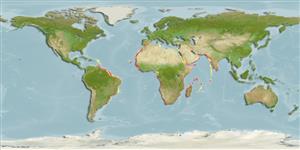
Benthic; diepte 0 - 50 m (Ref. 101292). Tropical; 10°C - 30°C (Ref. 113750), preferred 26°C (Ref. 107945); 37°N - 35°S, 64°W - 82°E
Western Indian Ocean, Atlantic Ocean and the Mediterranean Sea: from the southern Caribbean to Uruguay, eastern Atlantic from Portugal to Senegal, and Congo to South Africa, and in the western Indian Ocean from South Africa to Sri Lanka. Introduced in the Gulf of Mexico. Tropical and subtropical.
Lengte bij maturiteit / Grootte / Gewicht / Leeftijd
Maturiteit: Lm ? range ? - ? cm Max length : 17.0 cm SHL mannelijk / geslacht onbekend; (Ref. 271)
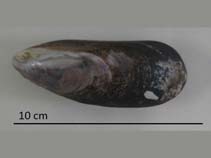
Shell mussel-shaped, ventral margin straight, posterior end rounded. Shell surface smooth except for fine growth lines. Hinge 1 or 2 teeth. Periostracum flaky. Colour: externally brown or light brown with concentric yellow bands near ventral margin, internally purple, nacreous.
It is heavily exploited commercially, stocks are dwindling in southernmost part or range. Consumed boiled in juices, marinated, grilled with rice, or in a number of different local dishes. Canned industrially (Ref. 271). Minimum depth from Ref. 104365. It is attached by byssus onto hard substrates, common in high-energy rocky coasts (Ref. 271). Feeds primarily on detritus (Ref. 114808).
Levenscyclus en paargedrag
Maturiteit | Voortplanting | Paaien | Eieren | Fecunditeit | Larven
Members of the class Bivalvia are mostly gonochoric, some are protandric hermaphrodites. Life cycle: Embryos develop into free-swimming trocophore larvae, succeeded by the bivalve veliger, resembling a miniature clam.
Carpenter, K.E. (ed.) 2002 The living marine resources of the Western Central Atlantic. Volume 1: Introduction, molluscs, crustaceans, hagfishes, sharks, batoid fishes, and chimaeras. FAO Species Identification Guide for Fishery Purposes and American Society of Ichthyologists and Herpetologists Special Publication No. 5, Rome. 600p. (Ref. 271)
Status op de Rode Lijst van het IUCN
(Ref. 130435: Version 2025-2 (Global))
CITES status (Ref. 108899)
Not Evaluated
Not Evaluated
Gevaar voor de mens
Gebruik door de mens
Visserij: van groot commercieel belang
FAO - Aquaculture Systems: production searchvisserij: landings search; Publication: search | FishSource | Sea Around Us
Tools
Meer informatie
LevenscyclusVoortplantingMaturiteitFecunditeitPaaienEierenOntwikkeling van de eierenLarven FysiologieZuurstofverbruik
Menselijk gerelateerdPostzegels, munten, diversen.
Internetbronnen
Schattingen op basis van modellen
Weerstandsvermogen
(Ref. 69278): |
Hoog, minimale populatieverdubbelingstijd minder dan 15 maanden (K=0.06-1.5) |
Kwetsbaarheid van de visserij
(Ref. 71543) |
Low to moderate vulnerability (29 of 100). |
Kwetsbaarheid voor het klimaat
(Ref. 125649) |
Moderate to high vulnerability (51 of 100) |
Prijsklasse
(Ref. 80766): |
Medium. |
Nutrients
|
Calcium = 149 [71, 228] mg/100g; Iron = 8.53 [1.95, 15.11] mg/100g; Protein = 9.88 [8.64, 11.12] %; Omega3 = 0.313 [0.202, 0.423] g/100g; Selenium = 61 [50, 72] μg/100g; VitaminA = 0 μg/100g; Zinc = 2.04 [0.56, 3.51] mg/100g (wet weight); based on nutrient studies. |