Bivalvia |
Mytilida |
Mytilidae
Umwelt: Milieu / Klimazone / Tiefenbereich / Verbreitungsgebiet
Ökologie
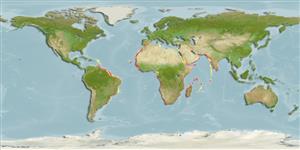
Benthic; tiefenbereich 0 - 50 m (Ref. 101292). Tropical; 10°C - 30°C (Ref. 113750), preferred 26°C (Ref. 107945); 37°N - 35°S, 64°W - 82°E
Western Indian Ocean, Atlantic Ocean and the Mediterranean Sea: from the southern Caribbean to Uruguay, eastern Atlantic from Portugal to Senegal, and Congo to South Africa, and in the western Indian Ocean from South Africa to Sri Lanka. Introduced in the Gulf of Mexico. Tropical and subtropical.
Länge bei der ersten Reifung / Größe / Gewicht / Alter
Geschlechtsreife: Lm ? range ? - ? cm Max length : 17.0 cm SHL Männchen/unbestimmt; (Ref. 271)
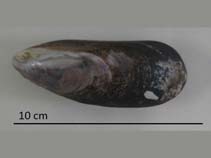
Shell mussel-shaped, ventral margin straight, posterior end rounded. Shell surface smooth except for fine growth lines. Hinge 1 or 2 teeth. Periostracum flaky. Colour: externally brown or light brown with concentric yellow bands near ventral margin, internally purple, nacreous.
It is heavily exploited commercially, stocks are dwindling in southernmost part or range. Consumed boiled in juices, marinated, grilled with rice, or in a number of different local dishes. Canned industrially (Ref. 271). Minimum depth from Ref. 104365. It is attached by byssus onto hard substrates, common in high-energy rocky coasts (Ref. 271). Feeds primarily on detritus (Ref. 114808).
Lebenszyklus und Paarungsverhalten
Geschlechtsreife | Fortpflanzung | Ablaichen | Eier | Fruchtbarkeit | Larven
Members of the class Bivalvia are mostly gonochoric, some are protandric hermaphrodites. Life cycle: Embryos develop into free-swimming trocophore larvae, succeeded by the bivalve veliger, resembling a miniature clam.
Carpenter, K.E. (ed.) 2002 The living marine resources of the Western Central Atlantic. Volume 1: Introduction, molluscs, crustaceans, hagfishes, sharks, batoid fishes, and chimaeras. FAO Species Identification Guide for Fishery Purposes and American Society of Ichthyologists and Herpetologists Special Publication No. 5, Rome. 600p. (Ref. 271)
IUCN Rote Liste Status
(Ref. 130435: Version 2025-2 (Global))
CITES Status (Ref. 108899)
Not Evaluated
Not Evaluated
Bedrohung für Menschen
Nutzung durch Menschen
Fischereien: hoch kommerziell
FAO - Aquaculture Systems: production searchFischereien: landings search; Publication: search | FishSource | Das Meer um uns herum
Tools
Mehr Information
LebenszyklusFortpflanzungGeschlechtsreifeFruchtbarkeitAblaichenEierEientwicklungLarven PhysiologieSauerstoffverbrauch
MenschenbezogenBriefmarken, Münzen, Verschiedenes.
Internet Quellen
Schätzungen auf der Grundlage von Modellen
Widerstandsfähigkeit
(Ref. 69278): |
hoch, Verdopplung der Population dauert weniger als 15 Monate. (K=0.06-1.5) |
Anfälligkeit der Fischerei
(Ref. 71543) |
Low to moderate vulnerability (29 of 100). |
Klimaanfälligkeit
(Ref. 125649) |
Moderate to high vulnerability (51 of 100) |
Preiskategorie
(Ref. 80766): |
Medium. |
Nutrients
|
Calcium = 149 [71, 228] mg/100g; Iron = 8.53 [1.95, 15.11] mg/100g; Protein = 9.88 [8.64, 11.12] %; Omega3 = 0.313 [0.202, 0.423] g/100g; Selenium = 61 [50, 72] μg/100g; VitaminA = 0 μg/100g; Zinc = 2.04 [0.56, 3.51] mg/100g (wet weight); based on nutrient studies. |