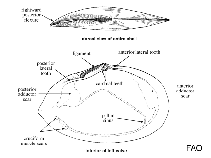
Bivalvia |
Cardiida |
Tellinidae
Milieu: milieu / Klimaatzone / Diepte / verspreidingsgebied
Ecologie
Benthic; brak water; diepte 0 - 270 m (Ref. 95344). Polar
Arctic, Northern Atlantic, Northeast Pacific and the Mediterranean Sea.
Lengte bij maturiteit / Grootte / Gewicht / Leeftijd
Maturiteit: Lm ? range ? - ? cm Max length : 3.8 cm SHL mannelijk / geslacht onbekend; (Ref. 95344); max. gerapporteerde leeftijd: 10 Jaren (Ref. 2823)
Maximum depth from Ref. 117961. Occurs from the upper part of the intertidal down to the shallow subtidal zone (Ref. 76547). Circumboreal and panarctic. Buries shallow to 20 cm under muddy-sandy substrate, commonly in bays and estuaries (Refs. 95344, 95753). In the northern Baltic Sea, known to thrive in eutrophic conditions (Ref. 95752). It is infaunal on sand and eelgrass beds and epifaunal on eelgrass beds (Ref. 95819). Deposit and suspension feeder (Refs. 76547, 96470). Surface deposit feeder (Ref. 66387). Feeds from the surface of the sediment using their long siphons (Ref. 7882), and is a subsurface detritivore (Refs. 95728, 96470).
Levenscyclus en paargedrag
Maturiteit | Voortplanting | Paaien | Eieren | Fecunditeit | Larven
Members of the class Bivalvia are mostly gonochoric, some are protandric hermaphrodites. Life cycle: Embryos develop into free-swimming trocophore larvae, succeeded by the bivalve veliger, resembling a miniature clam.
Vakily, J.M. 1992 Determination and comparison of bivalve growth, with emphasis on Thailand and other tropical areas. ICLARM Technical Report 36:1-125. (Ref. 7693)
Status op de Rode Lijst van het IUCN
(Ref. 130435: Version 2025-2 (Global))
CITES status (Ref. 108899)
Not Evaluated
Not Evaluated
Gevaar voor de mens
Gebruik door de mens
FAO - Publication: search | FishSource |
Tools
Meer informatie
Trofische ecologieVoedsel (prooien)DieetsamenstellingVoedselconsumptiePredatoren LevenscyclusVoortplantingMaturiteitFecunditeitPaaienEierenOntwikkeling van de eierenLarven FysiologieZuurstofverbruik
Menselijk gerelateerdPostzegels, munten, diversen.
Internetbronnen
Schattingen op basis van modellen
Weerstandsvermogen
(Ref. 69278): |
Gemiddeld, minimale populatieverdubbelingstijd 1,4-4,4 jaar (K=0-0.46; tmax=10) |
Kwetsbaarheid van de visserij
(Ref. 71543) |
Moderate vulnerability (37 of 100). |
Prijsklasse
(Ref. 80766): |
Unknown. |