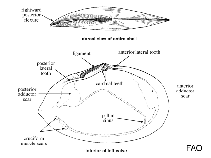
Bivalvia |
Cardiida |
Tellinidae
Môi trường: môi trường / vùng khí hậu / Mức độ sâu / phạm vi phân phối
Sinh thái học
Benthic; thuộc về nước lợ; mức độ sâu 0 - 270 m (Tài liệu tham khảo 95344). Polar
Arctic, Northern Atlantic, Northeast Pacific and the Mediterranean Sea.
Chiều dài lúc trưởng thành đầu tiên / Bộ gần gũi / Khối lượng (Trọng lượng) / Tuổi
Chín muồi sinh dục: Lm ? range ? - ? cm Max length : 3.8 cm SHL con đực/không giới tính; (Tài liệu tham khảo 95344); Tuổi cực đại được báo cáo: 10 các năm (Tài liệu tham khảo 2823)
Maximum depth from Ref. 117961. Occurs from the upper part of the intertidal down to the shallow subtidal zone (Ref. 76547). Circumboreal and panarctic. Buries shallow to 20 cm under muddy-sandy substrate, commonly in bays and estuaries (Refs. 95344, 95753). In the northern Baltic Sea, known to thrive in eutrophic conditions (Ref. 95752). It is infaunal on sand and eelgrass beds and epifaunal on eelgrass beds (Ref. 95819). Deposit and suspension feeder (Refs. 76547, 96470). Surface deposit feeder (Ref. 66387). Feeds from the surface of the sediment using their long siphons (Ref. 7882), and is a subsurface detritivore (Refs. 95728, 96470).
Vòng đời và hành vi giao phối
Chín muồi sinh dục | Sự tái sinh sản | Đẻ trứng | Các trứng | Sự sinh sản | Ấu trùng
Members of the class Bivalvia are mostly gonochoric, some are protandric hermaphrodites. Life cycle: Embryos develop into free-swimming trocophore larvae, succeeded by the bivalve veliger, resembling a miniature clam.
Vakily, J.M. 1992 Determination and comparison of bivalve growth, with emphasis on Thailand and other tropical areas. ICLARM Technical Report 36:1-125. (Tài liệu tham khảo 7693)
Tình trạng Sách đỏ IUCN
(Tài liệu tham khảo 130435: Version 2025-2 (Global))
tình trạng CITES (Tài liệu tham khảo 108899)
Not Evaluated
CMS (Tài liệu tham khảo 116361)
Not Evaluated
Mối đe dọa đối với con người
Sử dụng của con người
FAO - Publication: search | FishSource |
Các công cụ
Thêm thông tin
Vòng đờiSự tái sinh sảnChín muồi sinh dụcSự sinh sảnĐẻ trứngCác trứngSự phát triển của trứngẤu trùng Sinh lý họcThành phần ô-xy
Liên quan đến con ngườiTem, tiền xu, v.v.
Các nguồn internet
Ước tính dựa trên mô hình
Thích nghi nhanh
(Ref. 69278): |
Trung bình, thời gian nhân đôi của chủng quần tối thiểu là 1.4 - 4.4 năm (K=0-0.46; tmax=10) |
Sự dễ bị tổn thương của nghề đánh cá
(Tài liệu tham khảo 71543) |
Moderate vulnerability (37 of 100). |
Loại giá
(Tài liệu tham khảo 80766): |
Unknown. |