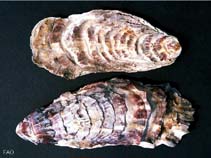
Bivalvia |
Ostreida |
Ostreidae
Umwelt: Milieu / Klimazone / Tiefenbereich / Verbreitungsgebiet
Ökologie
Benthic; brackwasser; tiefenbereich 0 - 15 m (Ref. 348). Subtropical; 15°C - 30°C (Ref. 76803), preferred 13°C (Ref. 107945); 62°N - 21°N, 113°E - 174°E
Northwest Pacific: from Hong Kong, east to Taiwan, and north to Kamchatka, Russia. Introduced in the rest of the Pacific, Atlantic, Indian Ocean and the Mediterranean.
Länge bei der ersten Reifung / Größe / Gewicht / Alter
Geschlechtsreife: Lm ? range ? - ? cm Max length : 45.0 cm SHL Männchen/unbestimmt; (Ref. 348); common length : 15.0 cm SHL Männchen/unbestimmt; (Ref. 348)
A major commercial species. Introduced for aquaculture in many countries. However experimental plantings in tropical western Pacific Islands often failed, apparently because of the sustained high temperature of the water (Ref. 348). Littoral and circalittoral rock and other hard substrata as well as littoral and sublittoral sediments (Ref. 1314). It is a sessile-burrower, suspension feeder (Ref. 96498).
Lebenszyklus und Paarungsverhalten
Geschlechtsreife | Fortpflanzung | Ablaichen | Eier | Fruchtbarkeit | Larven
Poutiers, J.M. 1998 Bivalves. Acephala, Lamellibranchia, Pelecypoda. p. 123-362. In Carpenter, K. E. and V. H. Niem. 1998. FAO species identification guide for fishery purposes. The living marine resources of the Western Central Pacific. Volume 1. Seaweeds, corals, bivalves, and gastropods. Rome, FAO. (Ref. 348)
IUCN Rote Liste Status
(Ref. 130435: Version 2025-2 (Global))
CITES Status (Ref. 108899)
Not Evaluated
Not Evaluated
Bedrohung für Menschen
Nutzung durch Menschen
Fischereien: kommerziell
FAO - Aquaculture Systems: Artbeschreibung, production search; Fischereien: Artbeschreibung, landings search; Publication: search | FishSource | Das Meer um uns herum
Tools
Mehr Information
LebenszyklusFortpflanzungGeschlechtsreifeFruchtbarkeitAblaichenEierEientwicklungLarven PhysiologieSauerstoffverbrauch
MenschenbezogenBriefmarken, Münzen, Verschiedenes.
Internet Quellen
Schätzungen auf der Grundlage von Modellen
Widerstandsfähigkeit
(Ref. 69278): |
hoch, Verdopplung der Population dauert weniger als 15 Monate. (K=0.01-2.69) |
Rate of population increase
|
Prior r = 0.57, 95% CL = 0.37 - 0.85, Based on 3 data-limited stock assessments. |
Anfälligkeit der Fischerei
(Ref. 71543) |
Low vulnerability (23 of 100). |
Klimaanfälligkeit
(Ref. 125649) |
Moderate to high vulnerability (55 of 100) |
Preiskategorie
(Ref. 80766): |
High. |
Nutrients
|
Calcium = 149 [71, 228] mg/100g; Iron = 8.53 [1.95, 15.11] mg/100g; Protein = 9.88 [8.64, 11.12] %; Omega3 = 0.313 [0.202, 0.423] g/100g; Selenium = 61 [50, 72] μg/100g; VitaminA = 0 μg/100g; Zinc = 2.04 [0.56, 3.51] mg/100g (wet weight); based on nutrient studies. |