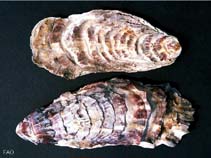
Bivalvia |
Ostreida |
Ostreidae
สิ่งแวดล้อม : สิ่งแวดล้อม / เขตภูมิอากาศ / ระดับความลึก / ระยะการกระจายสินค้า
นิเวศวิทยา
Benthic; กร่อย; ระดับความลึก 0 - 15 m (อ้างอิง 348). Subtropical; 15°C - 30°C (อ้างอิง 76803), preferred 13°C (อ้างอิง 107945); 62°N - 21°N, 113°E - 174°E
Northwest Pacific: from Hong Kong, east to Taiwan, and north to Kamchatka, Russia. Introduced in the rest of the Pacific, Atlantic, Indian Ocean and the Mediterranean.
ความยาวเมื่อครบกำหนดครั้งแรก / ขนาด / น้ำหนัก / อายุ
วัยเจริญพันธุ์: Lm ? range ? - ? cm Max length : 45.0 cm SHL เพศผู้/กระเทย; (อ้างอิง 348); common length : 15.0 cm SHL เพศผู้/กระเทย; (อ้างอิง 348)
A major commercial species. Introduced for aquaculture in many countries. However experimental plantings in tropical western Pacific Islands often failed, apparently because of the sustained high temperature of the water (Ref. 348). Littoral and circalittoral rock and other hard substrata as well as littoral and sublittoral sediments (Ref. 1314). It is a sessile-burrower, suspension feeder (Ref. 96498).
วงจรชีวิตและพฤติกรรมการผสมพันธุ์
วัยเจริญพันธุ์ | การสืบพันธุ์ | การวางไข่ | เซลสืบพันธ์ของเพศเมีย(ไข่) | ความดกของไข่ | ตัวอ่อน
Poutiers, J.M. 1998 Bivalves. Acephala, Lamellibranchia, Pelecypoda. p. 123-362. In Carpenter, K. E. and V. H. Niem. 1998. FAO species identification guide for fishery purposes. The living marine resources of the Western Central Pacific. Volume 1. Seaweeds, corals, bivalves, and gastropods. Rome, FAO. (อ้างอิง 348)
สถานะบัญชีแดงของ IUCN
(อ้างอิง 130435: Version 2025-2 (Global))
สถานะไซเตส (อ้างอิง 108899)
Not Evaluated
CMS (อ้างอิง 116361)
Not Evaluated
ภัยคุกคามต่อมนุษย์
การใช้ของมนุษย์
การประมง: การค้า
FAO - Aquaculture Systems: โปรไฟล์สายพันธุ์, production search; การประมง: โปรไฟล์สายพันธุ์, landings search; Publication: search | FishSource | ทะเลรอบๆเรา
เครื่องมือ
ข้อมูลเพิ่มเติม
วงจรชีวิตการสืบพันธุ์วัยเจริญพันธุ์ความดกของไข่การวางไข่เซลสืบพันธ์ของเพศเมีย(ไข่)การพัฒนาไข่ตัวอ่อน เกี่ยวข้องกับมนุษย์แสตมป์ เหรียญ อื่นๆ
แหล่งที่มาจากอินเตอร์เน็ต
การประมาณค่าตามแบบจำลอง
ความสามารถในการกลับคืนสู่ปกติ
(Ref. 69278): |
ความสูง, เวลาต่ำสุดที่จะทำให้ประชากรเพิ่มขึ้นเป็น 2 เท่าใช้เวลาน้อยกว่า 15 เดือน (K=0.01-2.69) |
Rate of population increase
|
Prior r = 0.57, 95% CL = 0.37 - 0.85, Based on 3 data-limited stock assessments. |
ความเสี่ยงต่อการตกปลา
(อ้างอิง 71543) |
Low vulnerability (23 of 100). |
ความเสี่ยงต่อสภาพภูมิอากาศ
(อ้างอิง 125649) |
Moderate to high vulnerability (55 of 100) |
หมวดหมู่ราคา
(อ้างอิง 80766): |
High. |
Nutrients
|
Calcium = 149 [71, 228] mg/100g; Iron = 8.53 [1.95, 15.11] mg/100g; Protein = 9.88 [8.64, 11.12] %; Omega3 = 0.313 [0.202, 0.423] g/100g; Selenium = 61 [50, 72] μg/100g; VitaminA = 0 μg/100g; Zinc = 2.04 [0.56, 3.51] mg/100g (wet weight); based on nutrient studies. |