Bivalvia |
Cardiida |
Cardiidae
Milieu: milieu / Klimaatzone / Diepte / verspreidingsgebied
Ecologie
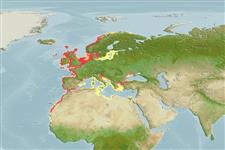
Benthic; brak water; diepte 0 - 5 m (Ref. 125442). Subtropical, preferred 10°C (Ref. 107945); 71°N - 14°N, 17°W - 33°E (Ref. 107077)
Eastern Atlantic, the Mediterranean and Black Sea: from Portugal to Egypt, north to Norway and Russia then south to Senegal, including Mediterranean and Black Sea. Occurrence in Iran, Persian Gulf is questionable.
Lengte bij maturiteit / Grootte / Gewicht / Leeftijd
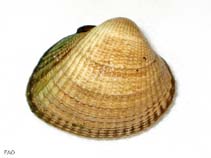
Maturiteit: Lm ? range ? - ? cm Max length : 5.6 cm SHL mannelijk / geslacht onbekend; (Ref. 101424); common length : 3.5 cm SHL mannelijk / geslacht onbekend; (Ref. 437); max. gerapporteerde leeftijd: 7 Jaren (Ref. 2823)
The Burry Inlet Cockle Fishery of this species has been certified by the Marine Stewardship Council (http://www.msc.org/) as well-managed and sustainable (http://www.msc.org/html/content_486.htm). Found in shallow coastal and estuary areas (Ref. 95774); in the subtidal zone (Ref. 96507). Inhabits the seagrass meadows Zostera noltii and Cymodocea nodosa in sand flats (Ref. 106872). Also found on intertidal muddy sand flat. Infaunal (Ref. 106873). A deposit (Ref. 96459), and suspension feeder (Refs. 96498, 106872, 106873) that is a sessile-burrower (Ref. 96498). Feeds on microphytobenthos and particulate organic matter (Ref. 106873).
Levenscyclus en paargedrag
Maturiteit | Voortplanting | Paaien | Eieren | Fecunditeit | Larven
Members of the class Bivalvia are mostly gonochoric, some are protandric hermaphrodites. Life cycle: Embryos develop into free-swimming trocophore larvae, succeeded by the bivalve veliger, resembling a miniature clam.
Fischer, W., G. Bianchi and W.B. Scott (eds.) 1981 Bivalves. 6: pag.var. In FAO species identification sheets for fishery purposes. Eastern Central Atlantic (fishing areas 34, 47; in part). Canada Funds-in-Trust. Ottawa, Department of Fisheries and Oceans Canada, by arrangement with the Food and AgriculturesOrganization of the United Nations, 1-7: pag.var. (Ref. 437)
Status op de Rode Lijst van het IUCN
(Ref. 130435: Version 2025-2 (Global))
CITES status (Ref. 108899)
Not Evaluated
Not Evaluated
Gevaar voor de mens
Gebruik door de mens
Visserij: commercieel
FAO - Aquaculture Systems: production searchvisserij: soortsprofiel, landings search; Publication: search | FishSource | Sea Around Us
Tools
Meer informatie
LevenscyclusVoortplantingMaturiteitFecunditeitPaaienEierenOntwikkeling van de eierenLarven FysiologieZuurstofverbruik
Menselijk gerelateerdPostzegels, munten, diversen.
Internetbronnen
Schattingen op basis van modellen
Weerstandsvermogen
(Ref. 69278): |
Hoog, minimale populatieverdubbelingstijd minder dan 15 maanden (K=0.46-0.66; tmax=7) |
Rate of population increase
|
Prior r = 0.49, 95% CL = 0.33 - 0.74, Based on 1 data-limited stock assessment. |
Kwetsbaarheid van de visserij
(Ref. 71543) |
Low to moderate vulnerability (28 of 100). |
Kwetsbaarheid voor het klimaat
(Ref. 125649) |
High vulnerability (56 of 100) |
Prijsklasse
(Ref. 80766): |
Medium. |
Nutrients
|
Calcium = 149 [71, 228] mg/100g; Iron = 8.53 [1.95, 15.11] mg/100g; Protein = 9.88 [8.64, 11.12] %; Omega3 = 0.313 [0.202, 0.423] g/100g; Selenium = 61 [50, 72] μg/100g; VitaminA = 0 μg/100g; Zinc = 2.04 [0.56, 3.51] mg/100g (wet weight); based on nutrient studies. |