Bivalvia |
Venerida |
Veneridae
पर्यावरण: पर्यावरण / जलवायु क्षेत्र / गहराई सीमा / वितरण सीमा
पारिस्थितिकी
Benthic; गहराई सीमा 0 - 20 m. Tropical; 40°N - 15°N, 99°W - 65°W
Western Central Atlantic.
प्रथम परिपक्वता पर लंबाई / आकार / वज़न / आयु
परिपक्व अवधि: Lm ? range ? - ? cmCommon length : 15.0 cm TL पुल्लिंग / अलिंग; (संदर्भ 344)
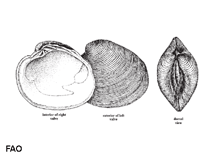
Shell thick, more inflated than in Mercenaria mercenaria, ovate-trigonal. Sculpture of irregular lines, more separated than in M. mercenaria. Lines never absent in middle of valve. Lunule as long as wide. Colour: dull white to grey, internally sometimes stained with purple.
One of the most commercially exploited species in the area. Species is harvested by digging in shallow water. Also collected by recreational fishermen by "treading" (probing with bare feet), and in deeper water by bull rakes and clam tongs. Mechanical harvesting not permitted in Florida. Species is high in protein and virtually fat-free. This species may form hybrids with individuals of M. mercenaria in the southeastern USA (Ref. 344). Combination depth range: min from literature, max from estimate. Lives from the intertidal to the shallow subtidal, in moderately hard sandy bottoms or in sandy mud. Sometimes in close associations with seagrass beds and algae. Rarely found in the surf zone (Ref. 344).
जीवन चक्र और संभोग व्यवहार
परिपक्व अवधि | पुनरुत्पत्ति | मछलीऔ का अंडे देना | अंडे | उपजाऊपन | लार्वा
Members of the class Bivalvia are mostly gonochoric, some are protandric hermaphrodites. Life cycle: Embryos develop into free-swimming trocophore larvae, succeeded by the bivalve veliger, resembling a miniature clam.
Leal, J.H. 2003 Bivalves. p. 25-98. In Carpenter, K.E. (ed.). The living marine resources of the Western Central Atlantic. Volume 1: Introduction, molluscs, crustaceans, hagfishes, sharks, batoid fishes, and chimaeras. FAO Species Identification Guide for Fishery Purposes and American Society of Ichthyologists and Herpetologists Special Publication No. 5. 1600p. (संदर्भ 344)
आईयूसीएन रेड लिस्ट स्थिति
(संदर्भ 130435: Version 2025-2 (Global))
CITES स्थिति (संदर्भ 108899)
Not Evaluated
CMS (संदर्भ 116361)
Not Evaluated
मनुष्यों के लिए ख़तरा
Harmless
मानव उपयोग
मात्स्यिकी: उच्च वाणिज्य
FAO - Publication: search | FishSource |
साधन
अधिक जानकारी
ट्रॉफिक पारिस्थितिकीखाद्य पदार्थ (शिकार)
संघटक आहार
आहार खपत
परभक्षी
जनसंख्या गतिशीलताबाढ़अधिकतम आयु/आकारलंबाई-वजन संबंधलंबाई-लंबाई संबंधलंबाई-आवृत्तियाँसामूहिक रूपांतरणबहुतायत जीवन चक्रपुनरुत्पत्तिपरिपक्व अवधिउपजाऊपनमछलीऔ का अंडे देनाअंडेअंडे का विकासलार्वा फिजियोलॉजीप्राणवायु की खपत
मानव संबंधीटिकट, सिक्के, विविध.
इंटरनेट स्रोत
मॉडल पर आधारित अनुमान
लौटाव
(Ref. 69278): |
ऊंचा, न्यूनतम जनसंख्या दुगनी समय अवलागत 15 महीने। (K=0.64) |
मछली पकड़ने की भेद्यता
(संदर्भ 71543) |
(0 of 100). |
मूल्य श्रेणी
(संदर्भ 80766): |
Medium. |