Bivalvia |
Venerida |
Veneridae
Miljö: miljö / Klimatzon / djupintervall / distributionsområde
Ekologi
Benthic; djupintervall 0 - 20 m. Tropical; 40°N - 15°N, 99°W - 65°W
Western Central Atlantic.
Längd vid första mognad / Storlek / Vikt / Ålder
Könsmognad: Lm ? range ? - ? cmCommon length : 15.0 cm TL hane/ej könsbestämd; (Ref. 344)
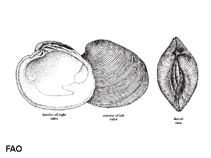
Shell thick, more inflated than in Mercenaria mercenaria, ovate-trigonal. Sculpture of irregular lines, more separated than in M. mercenaria. Lines never absent in middle of valve. Lunule as long as wide. Colour: dull white to grey, internally sometimes stained with purple.
One of the most commercially exploited species in the area. Species is harvested by digging in shallow water. Also collected by recreational fishermen by "treading" (probing with bare feet), and in deeper water by bull rakes and clam tongs. Mechanical harvesting not permitted in Florida. Species is high in protein and virtually fat-free. This species may form hybrids with individuals of M. mercenaria in the southeastern USA (Ref. 344). Combination depth range: min from literature, max from estimate. Lives from the intertidal to the shallow subtidal, in moderately hard sandy bottoms or in sandy mud. Sometimes in close associations with seagrass beds and algae. Rarely found in the surf zone (Ref. 344).
Livscykel och parningsbeteende
Könsmognad | Reproduktion | Lek | Ägg | Fekunditet | Larver
Members of the class Bivalvia are mostly gonochoric, some are protandric hermaphrodites. Life cycle: Embryos develop into free-swimming trocophore larvae, succeeded by the bivalve veliger, resembling a miniature clam.
Leal, J.H. 2003 Bivalves. p. 25-98. In Carpenter, K.E. (ed.). The living marine resources of the Western Central Atlantic. Volume 1: Introduction, molluscs, crustaceans, hagfishes, sharks, batoid fishes, and chimaeras. FAO Species Identification Guide for Fishery Purposes and American Society of Ichthyologists and Herpetologists Special Publication No. 5. 1600p. (Ref. 344)
Status på IUCN:s rödlista
(Ref. 130435: Version 2025-2 (Global))
CITES-status (Ref. 108899)
Not Evaluated
Not Evaluated
Hot mot människor
Harmless
Mänskliga användningsområden
Fiskeri: kommersiellt viktig
FAO - Publication: search | FishSource |
Verktyg
Ytterligare information
Trofisk ekologiLivsmedelsartiklar (preys)
Födosammansättning
Födointag
Predatorer
PopulationsdynamikTillväxtMax. åldrar / storlekarLängd-vikt rel.Längd-längd rel.Längd-frekvenserMassakonverteringAbundans LivscykelReproduktionKönsmognadFekunditetLekÄggUtveckling av äggLarver MänniskorelateradFrimärken, mynt, diverse.
Internet-källor
Uppskattningar baserade på modeller
Resiliens
(Ref. 69278): |
Hög, lägsta populationsfördubblingstid mindre än 15 månader (K=0.64) |
Sårbarhet i fisket
(Ref. 71543) |
(0 of 100). |
Priskategori
(Ref. 80766): |
Medium. |