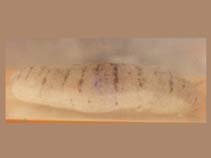

Holothuria scabra, Sand fish : fisheries
Advertisement

You can sponsor this page

Holothuria scabra   Jaeger, 1833

Sand fish

Native range | All suitable habitat | Point map | Year 2050
This map was computer-generated and has not yet been reviewed.
Holothuria scabra  AquaMaps  Data sources: GBIF OBIS
上傳你的 相片 
所有照片 | Google 影像 |
Image of Holothuria scabra (Sand fish)
Holothuria scabra
Picture by Batoy, Corazon B.

分類 / 名稱 俗名 | 同種異名 | CoL | ITIS | WoRMS

Holothuroidea | Holothuriida | Holothuriidae

環境: 環境 / 氣候帶 / 深度上下限 / 配送範圍 生態學

礁區魚類; 深度上下限 0 - 10 m (參考文獻 122).  Tropical; 30°N - 27°S, 32°E - 172°W (參考文獻 107065)

分布 Territories | FAO區域 | 生態系 | 發現紀錄 | 簡介

Indo-Pacific, excluding Hawaii.

初熟時的長度 / 大小 / 重量 / 年齡

成熟度: Lm ?, range 16 - ? cm Max length : 40.0 cm TL 雄魚/尚未辨別雌雄; (參考文獻 418); common length : 22.0 cm TL 雄魚/尚未辨別雌雄; (參考文獻 122); 最大體重: 1.5 kg (參考文獻 418)

簡短描述 型態特徵

Maximum total length: 35 cm, commonly 22 cm. Mean live weight: 300 g up to 1000 g (Ref. 122);1500 g (Ref. 418). Body-wall thickness: 0.6 cm. Body: oval, arched dorsally (bivium) and flattened ventrally (trivium). Bivium with characteristics wrinkles, covered by sediment when the animal is coming out of the bottom. Bivium with small papillae within black dots, and black podia ending in a disc of around 0.022 cm diameter; podia on trivium arranged irregularly, their calcareous disc around 0.035 cm in diameter. Mouth: ventral, surrounded by a collar of papillae and 20 grey, short and stout tentacles. Anus terminal, surrounded by a circle of 5 groups of radial papillae. Calcareous ring with a large medioventral radial piece. Cuvierian tubules absent. Color: highly variable; bivium whitish to dark brown, occasionally with dark transverse markings; trivium lighter, generally whitish. Spicules: very numerous; ventral tegument with tables and buttons, the tables having a moderately small disc, perforated by a varying number of holes of variable size, the spire with 4 pillars and a cross-like bridge, ending in a spiny crown with a hole in the middle; knobby buttons generally have 6 holes, occasionally more; small rods and denticulate plates also present; tables and buttons in dorsal tegument: tables with a nodose disc, much larger than in ventral tegument; buttons variable, larger, and more perforated than those in ventral tegument; ventral and dorsal podia with long and large spinose rods; tentacles with long spiny rods, small smooth rods, and large denticulate plates (Ref. 122).

生物學特性     字彙 (例如 附生動物)

Populations can reach high densities up to 1 per square meter. Provides the principal share of the tropical Indo-Pacific production of béche-de-mer and is harvested throughout the area in artisanal fisheries. Collected by hand while wading on the reefs at low tide. The processing method is particular of this species: the sea cucumbers are buried overnight, and the next day the numerous spicules are removed by brushing the tegument. The processed product is of major commercial value and at present highly demanded (Ref. 122). Found in shallow waters, rarely in depths of more than 10 m; mostly on inner reef flats of fringing and lagoon-islets reefs, coastal areas under terrigenous influence, and near mangroves. Burrows in mud and sandy-muddy bottoms (Also Ref. 129602) where the populations can reach high densities up to 1 per square meter (Ref. 122). Found in silty sand, often near low saline areas and frequently on Cymodocea sp. beds, from the intertidal to a depth of 10 m. It buries in sand part of the day but is gregarious in nature (Ref. 118). Also found in intertidal seagrass beds (Refs. 106849, 129602). Benthic detritus feeder; assimilates organic matter from muddy sandy sediments, among other food sources (Ref. 101695).

生命週期和交配行為 成熟度 | 繁殖 | 產卵場 | | 孕卵數 | 仔魚

Sexual reproduction takes place during warm season. A species with a high potential fecundity and early sexual maturity (Ref. 122).

主要參考資料 參考文獻 | 合作者 | 合作者

Conand, C. 1998 Holothurians (sea cucumbers, Class Holothuroidea). p. 1157-1190. In Carpenter, K.E. and V.H. Niem (eds.) FAO Species Identification Guide for Fishery Purposes. The Living Marine Resources of the Western Central Pacific. Vol. 2. Cephalopods, crustaceans, holothurians and sharks. FAO Rome. (參考文獻 122)

IUCN 瀕危狀態 (參考文獻 130435: Version 2025-2 (Global))

  瀕危 (EN) (A2bd); Date assessed: 18 May 2010

CITES狀態 (參考文獻 108899)

Not Evaluated

CMS (參考文獻 116361)

Not Evaluated

對人類具威脅

人類使用

漁業: 高經濟性
FAO - Publication: search | FishSource |

工具

更多資訊

營養生態學
食物項目(獵物)
食性組成
食物消耗量
捕食者
生態學
人口動態
成長
最大年齡/尺寸
長度重量比
長度關係
長度-頻率
質量轉換
豐度
生命週期
生理學
耗氧量
人類相關
郵票、錢幣、雜項
外展服務
參考文獻

網路資源

BHL | BOLD Systems | CISTI | DiscoverLife | FAO - Publication: search | Fishipedia | GenBank (基因組, 核甘) | GloBI | Gomexsi | Google Books | Google Scholar | Google | PubMed | 樹狀分類階層 | Wikipedia (, 搜尋) | 動物學的記錄

基於模型的估計

回復力
(Ref. 69278):
高度, 族群倍增時間少於 15個月 (K=0.52)
釣魚的脆弱性
(參考文獻 71543)
Moderate to high vulnerability (53 of 100).
價格種類
(參考文獻 80766):
Unknown.