Holothuroidea |
Holothuriida |
Holothuriidae
Milieu: milieu / Klimaatzone / Diepte / verspreidingsgebied
Ecologie
Benthic; diepte 1 - 125 m (Ref. 85345). Subtropical
Verspreiding
Territories | FAO regio's | Ecosystemen | Voorkomen | Introducties
Atlantic and the Mediterranean Sea.
Lengte bij maturiteit / Grootte / Gewicht / Leeftijd
Maturiteit: Lm ? range ? - ? cm Max length : 25.0 cm TL mannelijk / geslacht onbekend; (Ref. 358)
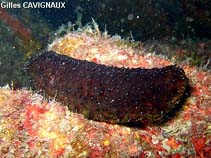
Maximum size: 25 cm. Body: with more or less round cross section; ventral face with 3 lines with parapodes with suction cup. Tegument: more fragile constellated with multiple papillae. Color: Brown; papillae, in a variable number, being of beige or white color, at always brown end. The animal is equipped with tubes of Vat which it expels with the least stimulus (Ref. 358).
Maximum size: 25 cm. Species presents at all depths. In the event of stimulus by contact, defends itself by expelling its tubes of Vat. Very adherent, they discourage frequently inclinations of the possible attackers or predatory. When the stimulus persist, the animal can go until excreting the whole of its digestive tract. The tubes of Vat and the bodies assigned to digestion are regenerated in the span of a few weeks if the conditions are favorable (Ref. 358). habitat: Hard funds of primary education types and secondary, more rarely in herbarium; very commune in the Mediterranean basin. Nourishes various organic fragments, (charging) literally the elements of the ground in its oral opening; located at the back of the body, using its tentacles oral of flattened form. The animal sorts and introduces the edible organic substances, and rejects the elements not metabolized, particularly sand, in the form of lengthened excrements (Ref. 358).
Levenscyclus en paargedrag
Maturiteit | Voortplanting | Paaien | Eieren | Fecunditeit | Larven
Members of the class Holothuroidea are gonochoric and have only one gonad. Spawning and fertilization are both external and some exhibit brooding. Life cycle: Embryos develop into planktotrophic larvae (auricularia) then into doliolaria (barrel-shaped stage) which later metamorphose into juvenile sea cucumbers.
Göthel, H. 1992 Guide de la faune sous-marine: La Méditerranée. Invertébrés marins et poissons. Eygen Ulmer GmbH & Co. 318 p. (Ref. 358)
Status op de Rode Lijst van het IUCN
(Ref. 130435: Version 2025-2 (Global))
CITES status (Ref. 108899)
Not Evaluated
Not Evaluated
Gevaar voor de mens
Gebruik door de mens
FAO - Publication: search | FishSource |
Tools
Meer informatie
Trofische ecologieVoedsel (prooien)
Dieetsamenstelling
Voedselconsumptie
Predatoren
LevenscyclusVoortplantingMaturiteitFecunditeitPaaienEierenOntwikkeling van de eierenLarven Menselijk gerelateerdPostzegels, munten, diversen.
Internetbronnen
Schattingen op basis van modellen
Weerstandsvermogen
(Ref. 69278): |
Hoog, minimale populatieverdubbelingstijd minder dan 15 maanden (K=0.66) |
Kwetsbaarheid van de visserij
(Ref. 71543) |
Low vulnerability (19 of 100). |
Prijsklasse
(Ref. 80766): |
Unknown. |