Demospongiae |
Verongiida |
Aplysinidae
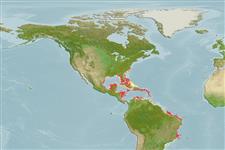
Milieu: milieu / Klimaatzone / Diepte / verspreidingsgebied
Ecologie
Sessile; brak water; diepte 3 - 52 m (Ref. 415). Tropical
Western Atlantic.
Lengte bij maturiteit / Grootte / Gewicht / Leeftijd
Maturiteit: Lm ? range ? - ? cm
Massive to lobate. Surface has knob-shaped conules; 0.3 - 0.4 cm high; up to 1 cm apart. Dense like cheese. Oscules with membranes; 1 - 2 cm wide; on top of lobes (Ref. 415). External is usually bicolored but highly variable at purple, greenish, red-brown, orange or bright yellow. Internal color is bright lemon yellow. Exudate is dark; turns bluish after air exposure for about an hour.
Maximum depth reported taken from Ref. 128739. Common in reefs (Ref. 85482) and sea grass (Ref. 415). Also found in mangroves (Ref. 86836). Hosts alpheid shrimps in its canals (Ref. 86626). Inhabits coral communities. Found in shallow coral reefs and mesophotic depths (Ref. 128739).
Levenscyclus en paargedrag
Maturiteit | Voortplanting | Paaien | Eieren | Fecunditeit | Larven
Members of the class Demospongiae are hermaphroditic. Life cycle: The zygote develops into parenchymella larva (free-swimming) before settling down on a substrate where it grows into a young sponge.
Collin, R., M.C. Díaz, J. Norenburg, R.M. Rocha, J.A. Sánchez, M. Schulze, A. Schwartz and A. Valdés 2005 Photographic identification guide to some common marine invertebrates of Bocas Del Toro, Panama. Caribbean Journal of Science. 41(3):638-707. (Ref. 415)
Status op de Rode Lijst van het IUCN
(Ref. 130435: Version 2025-2 (Global))
CITES status (Ref. 108899)
Not Evaluated
Not Evaluated
Gevaar voor de mens
Gebruik door de mens
FAO - Publication: search | FishSource |
Tools
Meer informatie
Trofische ecologieVoedsel (prooien)
Dieetsamenstelling
Voedselconsumptie
Predatoren
PopulatiedynamicaGroei
Max. leeftijden / maten
Lengte-gewicht rel.
Lengte-lengte rel.
Lengtefrequenties
Massaconversie
Abundantie
LevenscyclusVoortplantingMaturiteitFecunditeitPaaienEierenOntwikkeling van de eierenLarven FysiologieZuurstofverbruik
Menselijk gerelateerdPostzegels, munten, diversen.
Internetbronnen
Schattingen op basis van modellen
Kwetsbaarheid van de visserij
(Ref. 71543) |
(0 of 100). |
Prijsklasse
(Ref. 80766): |
Unknown. |