Demospongiae |
Verongiida |
Aplysinidae
Environnement : milieu / zone climatique / profondeur / gamme de distribution
Écologie
Sessile; saumâtre; profondeur 3 - 52 m (Réf. 415). Tropical
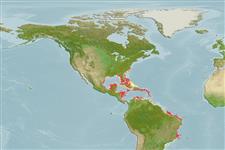
Western Atlantic.
Longueur à la première maturité / Taille / Poids / Âge
Maturité: Lm ? range ? - ? cm
Description synthétique
Morphologie
Massive to lobate. Surface has knob-shaped conules; 0.3 - 0.4 cm high; up to 1 cm apart. Dense like cheese. Oscules with membranes; 1 - 2 cm wide; on top of lobes (Ref. 415). External is usually bicolored but highly variable at purple, greenish, red-brown, orange or bright yellow. Internal color is bright lemon yellow. Exudate is dark; turns bluish after air exposure for about an hour.
Maximum depth reported taken from Ref. 128739. Common in reefs (Ref. 85482) and sea grass (Ref. 415). Also found in mangroves (Ref. 86836). Hosts alpheid shrimps in its canals (Ref. 86626). Inhabits coral communities. Found in shallow coral reefs and mesophotic depths (Ref. 128739).
Cycle de vie et comportement reproducteur
Maturité | Reproduction | Frai | Œufs | Fécondité | Larves
Members of the class Demospongiae are hermaphroditic. Life cycle: The zygote develops into parenchymella larva (free-swimming) before settling down on a substrate where it grows into a young sponge.
Collin, R., M.C. Díaz, J. Norenburg, R.M. Rocha, J.A. Sánchez, M. Schulze, A. Schwartz and A. Valdés 2005 Photographic identification guide to some common marine invertebrates of Bocas Del Toro, Panama. Caribbean Journal of Science. 41(3):638-707. (Réf. 415)
Statut dans la liste rouge de l'IUCN
(Réf. 130435: Version 2025-2 (Global))
statut CITES (Réf. 108899)
Not Evaluated
Not Evaluated
Menace pour l'homme
Utilisations par l'homme
FAO - Publication: search | FishSource |
Outils
Plus d'informations
Écologie trophiqueAliments (proies)
Composition du régime alimentaire
Consommation alimentaire
Prédateurs
Dynamique des populationsCroissance
Âges / tailles maximales
Longueur-poids rel.
Rel. longueur-longueur.
Fréquences de longueurs
Conversion de masse
Abondance
Cycle de vieReproductionMaturitéFéconditéFraiŒufsDéveloppement de l'œufLarves PhysiologieConsommation d'oxygène
Liées à l'hommeTimbres, pièces de monnaie, divers
Sources Internet
Estimations basées sur des modèles
Vulnérabilité de la pêche
(Réf. 71543) |
(0 of 100). |
Catégorie de prix
(Réf. 80766): |
Unknown. |