Pycnogonida |
Pantopoda |
Ammotheidae
Umwelt: Milieu / Klimazone / Tiefenbereich / Verbreitungsgebiet
Ökologie
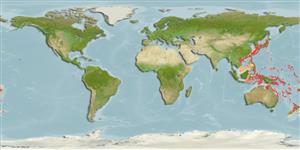
Benthic; tiefenbereich 90 - 300 m (Ref. 9). Tropical
Indo-West Pacific.
Länge bei der ersten Reifung / Größe / Gewicht / Alter
Geschlechtsreife: Lm ? range ? - ? cm
Trunk: moderately long, completely segmented, glabrous. Lateral processes: well separated, armed with 1-2 dorsodistal setae. Cephalic segment: extending slightly dorsal to tiny chelifores, ocular tubercle at centre of segment, little taller than basal diameter, small eyes at mid-length. Proboscis: short, only about 1.5 times longer than cephalic segment, cylindrical, slightly tapered distally. Abdomen: moderately short, erect. Chelifores: very slender, short, chelae atrophied, armed with few short distal setae. Palps: 9-segmented, Achelia-like, with few ventral setae. Ovigers: 10 segmented, fourth segment longest, second segment longer than fifth, sixth segment with denticulate spine, strigilis segments with 1 -2 denticulate spines with small single denticles to larger spines with many lateral denticles. Leg: major segments with several short tubercles each with long feathered (with many lateral setules) seta. Propodus: short, well curved, claw long, robust, tiny auxiliaries present, shorter than basal claw diameter. Male characters known (Ref. 9).
Continental shelf, slope (Ref. 1456 and 19).
Lebenszyklus und Paarungsverhalten
Geschlechtsreife | Fortpflanzung | Ablaichen | Eier | Fruchtbarkeit | Larven
Members of the class Pycnogonida are gonochoric and sexually dimorphic. During copulation, male usually suspends itself beneath the female. Fertilization occurs as the eggs leave the female's ovigers. Males brood the egg masses until they hatch. Life cycle: Eggs hatch into protonymphon larva then to adults.
Child, C.A. 1998 The marine fauna of New Zealand: Pycnogonida (sea spiders). NIWA Biodiversity Memoire 109. National Institute of Water and Atmospheric Research (NIWA). Washington, D.C. 20530, USA. 71 p. + Figure 2A-G, 3A-F, 4, 5. (Ref. 9)
IUCN Rote Liste Status
(Ref. 130435: Version 2025-2 (Global))
CITES Status (Ref. 108899)
Not Evaluated
Not Evaluated
Bedrohung für Menschen
Nutzung durch Menschen
FAO - Publication: search | FishSource |
Tools
Mehr Information
Trophische ÖkologieLebensmittel (Beutetiere)
Nahrungszusammensetzung
Nahrungsaufnahme
Räuber
PopulationsdynamikWachstum
Max. Alter/Größen
Länge-Gewicht-Rel.
Länge-Länge-Verhältnis.
Längenhäufigkeiten
Massenkonvertierung
Dichte
LebenszyklusFortpflanzungGeschlechtsreifeFruchtbarkeitAblaichenEierEientwicklungLarven PhysiologieSauerstoffverbrauch
MenschenbezogenBriefmarken, Münzen, Verschiedenes.
Internet Quellen
Schätzungen auf der Grundlage von Modellen
Anfälligkeit der Fischerei
(Ref. 71543) |
(0 of 100). |
Preiskategorie
(Ref. 80766): |
Unknown. |