Pycnogonida |
Pantopoda |
Ammotheidae
สิ่งแวดล้อม : สิ่งแวดล้อม / เขตภูมิอากาศ / ระดับความลึก / ระยะการกระจายสินค้า
นิเวศวิทยา
Benthic; ระดับความลึก 90 - 300 m (อ้างอิง 9). Tropical
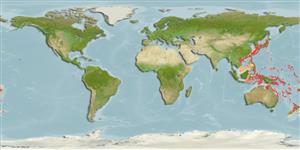
Indo-West Pacific.
ความยาวเมื่อครบกำหนดครั้งแรก / ขนาด / น้ำหนัก / อายุ
วัยเจริญพันธุ์: Lm ? range ? - ? cm
Trunk: moderately long, completely segmented, glabrous. Lateral processes: well separated, armed with 1-2 dorsodistal setae. Cephalic segment: extending slightly dorsal to tiny chelifores, ocular tubercle at centre of segment, little taller than basal diameter, small eyes at mid-length. Proboscis: short, only about 1.5 times longer than cephalic segment, cylindrical, slightly tapered distally. Abdomen: moderately short, erect. Chelifores: very slender, short, chelae atrophied, armed with few short distal setae. Palps: 9-segmented, Achelia-like, with few ventral setae. Ovigers: 10 segmented, fourth segment longest, second segment longer than fifth, sixth segment with denticulate spine, strigilis segments with 1 -2 denticulate spines with small single denticles to larger spines with many lateral denticles. Leg: major segments with several short tubercles each with long feathered (with many lateral setules) seta. Propodus: short, well curved, claw long, robust, tiny auxiliaries present, shorter than basal claw diameter. Male characters known (Ref. 9).
Continental shelf, slope (Ref. 1456 and 19).
วงจรชีวิตและพฤติกรรมการผสมพันธุ์
วัยเจริญพันธุ์ | การสืบพันธุ์ | การวางไข่ | เซลสืบพันธ์ของเพศเมีย(ไข่) | ความดกของไข่ | ตัวอ่อน
Members of the class Pycnogonida are gonochoric and sexually dimorphic. During copulation, male usually suspends itself beneath the female. Fertilization occurs as the eggs leave the female's ovigers. Males brood the egg masses until they hatch. Life cycle: Eggs hatch into protonymphon larva then to adults.
Child, C.A. 1998 The marine fauna of New Zealand: Pycnogonida (sea spiders). NIWA Biodiversity Memoire 109. National Institute of Water and Atmospheric Research (NIWA). Washington, D.C. 20530, USA. 71 p. + Figure 2A-G, 3A-F, 4, 5. (อ้างอิง 9)
สถานะบัญชีแดงของ IUCN
(อ้างอิง 130435: Version 2025-2 (Global))
สถานะไซเตส (อ้างอิง 108899)
Not Evaluated
CMS (อ้างอิง 116361)
Not Evaluated
ภัยคุกคามต่อมนุษย์
การใช้ของมนุษย์
FAO - Publication: search | FishSource |
เครื่องมือ
ข้อมูลเพิ่มเติม
นิเวศวิทยาเขตร้อนรายการอาหาร (เหยื่อ)
องค์ประอบของอาหาร
การบริโภคอาหาร
ผู้ล่า
พลวัตของประชากรการเจริญเติบโต
อายุสูงสุด / ขนาด
ความยาว-น้ำหนักสัมพันธ์
ความยาว-ความยาวสัมพันธ์
ความยาว-ความถี่
การแปลงมวล
อุดมสมบรูณ์
วงจรชีวิตการสืบพันธุ์วัยเจริญพันธุ์ความดกของไข่การวางไข่เซลสืบพันธ์ของเพศเมีย(ไข่)การพัฒนาไข่ตัวอ่อน เกี่ยวข้องกับมนุษย์แสตมป์ เหรียญ อื่นๆ
แหล่งที่มาจากอินเตอร์เน็ต
การประมาณค่าตามแบบจำลอง
ความเสี่ยงต่อการตกปลา
(อ้างอิง 71543) |
(0 of 100). |
หมวดหมู่ราคา
(อ้างอิง 80766): |
Unknown. |