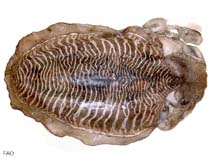
Cephalopoda |
Sepiida |
Sepiidae
Môi trường: môi trường / vùng khí hậu / Mức độ sâu / phạm vi phân phối
Sinh thái học
Benthic; mức độ sâu 0 - 130 m (Tài liệu tham khảo 1695), usually ? - 40 m (Tài liệu tham khảo 275). Tropical; 41°N - 26°S, 32°E - 151°E (Tài liệu tham khảo 1695)
Indo-West Pacific and the Mediterranean Sea: from Red Sea to Japan and Australia.
Chiều dài lúc trưởng thành đầu tiên / Bộ gần gũi / Khối lượng (Trọng lượng) / Tuổi
Chín muồi sinh dục: Lm 12.2, range 5 - 24 cm Max length : 43.0 cm ML con đực/không giới tính; (Tài liệu tham khảo 275); 33 cm ML (female); Khối lượng cực đại được công bố: 5.0 kg (Tài liệu tham khảo 275); Khối lượng cực đại được công bố: 5.0 kg
Common sizes in landings range from 15 to 20 cm (Ref. 3722). This species supports industrial or artisanal fisheries throughout its range. Mostly fished and abundant in Gulf and the Andaman Sea. This species has been grown successfully in culture and techniques are being developed to culture the animals commercially (Ref. 1695). Minimum depth from Ref. 103582. Benthic (Ref. 105085). Epibenthic (Ref. 116259). Most common in shallow coastal waters (Ref. 801). Commonly found over sand and seagrass beds (Ref. 102838). Active predator and exhibits cannibalism (Ref. 105085). Feeds on crustaceans, small fish (Refs. 801, 9773) and cephalopods (Ref. 105085). Able to change color rapidly (Ref. 102838). Coastal demersal. Forms groups during spawning at depths of at most 20m (Ref. 9773).
Members of the class Cephalopoda are gonochoric. Male and female adults usually die shortly after spawning and brooding, respectively. Mating behavior: Males perform various displays to attract potential females for copulation. During copulation, male grasp the female and inserts the hectocotylus into the female's mantle cavity where fertilization usually occurs. Life cycle: Embryos hatch into planktonic stage and live for some time before they grow larger and take up a benthic existence as adults.
Jereb, P. and C.F.E. Roper (eds.) 2005 Cephalopods of the world. An Annotated and Illustrated catalogue of Cephalopod species known to date. Vol. 1. Chambered nautiluses and sepioids (Nautilidae, Sepiidae, Sepiolidae, Sepiadariidae, Idiosepiidae and Spirulidae). FAO Spec. Cat. Fish. Purp. 4(1):262p. Rome: FAO. (Tài liệu tham khảo 1695)
Tình trạng Sách đỏ IUCN
(Tài liệu tham khảo 130435: Version 2025-2 (Global))
tình trạng CITES (Tài liệu tham khảo 108899)
Not Evaluated
CMS (Tài liệu tham khảo 116361)
Not Evaluated
Mối đe dọa đối với con người
Sử dụng của con người
Các nghề cá: tính thương mại; Nuôi trồng thủy sản: tính thương mại; Bể nuôi cá: Tiềm năng
FAO - Publication: search | FishSource |
Các công cụ
Thêm thông tin
Sinh lý họcThành phần ô-xy
Liên quan đến con ngườiTem, tiền xu, v.v.
Các nguồn internet
Ước tính dựa trên mô hình
Thích nghi nhanh
(Ref. 69278): |
Chiêù cao, thời gian nhân đôi của chủng quần tối thiểu là dưới 15 tháng (K=0.46-1.69) |
Sự dễ bị tổn thương của nghề đánh cá
(Tài liệu tham khảo 71543) |
Low vulnerability (22 of 100). |
Loại giá
(Tài liệu tham khảo 80766): |
High. |