Cephalopoda |
Myopsida |
Loliginidae
Môi trường: môi trường / vùng khí hậu / Mức độ sâu / phạm vi phân phối
Sinh thái học
Sống nổi và đáy; mức độ sâu 0 - 500 m (Tài liệu tham khảo 275), usually 20 - 250 m (Tài liệu tham khảo 275). Temperate; 13°C - 20°C (Tài liệu tham khảo 2453), preferred 18°C (Tài liệu tham khảo 107945); 60°N - 36°S, 19°W - 37°E
Eastern Atlantic and the Mediterranean: from North Sea and British Isles to southwest Africa and the Mediterranean.
Chiều dài lúc trưởng thành đầu tiên / Bộ gần gũi / Khối lượng (Trọng lượng) / Tuổi
Chín muồi sinh dục: Lm 16.9, range 16 - 23 cm Max length : 64.0 cm ML con đực/không giới tính; (Tài liệu tham khảo 417); 32 cm ML (female); Khối lượng cực đại được công bố: 1.5 kg (Tài liệu tham khảo 275)
Paralarvae: Fins paddle-shaped, broad with short bases, fin much wider than long. Mantle broad with few large dorsal chromatophores and numerous ventral chromatophores. Head squarish with few chromatophores on dorsal surface and 12 chromatophores on ventral surface arranged in 2 cheek patches of 5 posterior to eyes and a pair between the eyes. Ventral arms with 2 aboral chromatophores. Tentacles with 4 aboral chromatophores. Tentacular clubs broad and wider than tentacular stalks. Mantle length at hatching range between mantle length 0.28 and 0.358 cm (Ref. 2489, 2490).
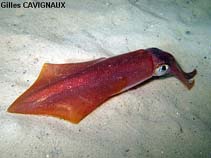
Juveniles and adults: Mantle muscular, cylindrical, slender and elongated posteriorly. Wide spots of red chromatophores in mantle and green/blue iridescence in posterior part of mantle. Fins rhomboid with length exceeding 50% of mantle length. Buccal membrane with 15 suckers with chitinous rings on extremity. Male's left ventral arm hectocotylized with length ranging from 15 to 33% of whole arm length. Arms with 2 rows of suckers, sucker rings with 20 teeth, distal ones large and pointed and proximal ones minute or absent. Tentacles not retractile and tentacular clubs with 4 longitudinal rows of suckers in the "manus", which in central rows are larger than marginal ones. Cartilages simple locking (Ref. 275, 1964).
Maximum life span: 1.5 to 2 years in females and 3 to 3.5 years in males (Ref. 2525). Maximum size for male, 64 cm, mantle length from Ref. 2494. Neither pelagic nor fully benthic. Inhabits circumlittoral zone and upper bottoms of bathyal systems (Ref. 2504). Exhibits benthic behavior during spawning season and pelagic behavior at other times, e.g., during hunting (Ref. 2493). Carnivorous predators (Ref. 2526); juvenile feeds on planktonic prey, e.g. copepods, mysids and euphausiids (Ref. 2525) while adult frequently feeds on fish (Ref. 2526) and sometimes on cephalopods and crustaceans.
Members of the class Cephalopoda are gonochoric. Male and female adults usually die shortly after spawning and brooding, respectively. Mating behavior: Males perform various displays to attract potential females for copulation. During copulation, male grasp the female and inserts the hectocotylus into the female's mantle cavity where fertilization usually occurs. Life cycle: Embryos hatch into planktonic stage and live for some time before they grow larger and take up a benthic existence as adults.
Piatkowski, U. 2006 Loligo vulgaris. European squid. Life history species review. CEPHSTOCK: Cephalopod Stocks in European Waters. Review, Analysis, Assessment and Sustainable Management. 25 p. (Tài liệu tham khảo 2488)
Tình trạng Sách đỏ IUCN
(Tài liệu tham khảo 130435: Version 2025-2 (Global))
tình trạng CITES (Tài liệu tham khảo 108899)
Not Evaluated
CMS (Tài liệu tham khảo 116361)
Not Evaluated
Mối đe dọa đối với con người
Sử dụng của con người
Các nghề cá: tính thương mại
FAO - Các nghề cá: landings search; Publication: search | FishSource | Biển chung quanh ta
Các công cụ
Thêm thông tin
Sinh lý họcThành phần ô-xy
Liên quan đến con ngườiTem, tiền xu, v.v.
Các nguồn internet
Ước tính dựa trên mô hình
Thích nghi nhanh
(Ref. 69278): |
Chiêù cao, thời gian nhân đôi của chủng quần tối thiểu là dưới 15 tháng (K=0.13-1.66; tm=0.78) |
Rate of population increase
|
Prior r = 0.39, 95% CL = 0.26 - 0.58, Based on 2 full stock assessments. |
Sự dễ bị tổn thương của nghề đánh cá
(Tài liệu tham khảo 71543) |
Low vulnerability (23 of 100). |
Sự dễ bị tổn thương của khí hậu
(Tài liệu tham khảo 125649) |
High vulnerability (61 of 100) |
Loại giá
(Tài liệu tham khảo 80766): |
Low. |
Nutrients
|
Calcium = 126 [75, 177] mg/100g; Iron = 4.79 [1.67, 7.92] mg/100g; Protein = 15.5 [13.7, 17.4] %; Omega3 = 0.414 [0.262, 0.566] g/100g; Selenium = 57.8 [48.5, 67.2] μg/100g; VitaminA = 0 μg/100g; Zinc = 1.97 [0.92, 3.02] mg/100g (wet weight); based on nutrient studies. |