Cephalopoda |
Oegopsida |
Ommastrephidae | Todarodinae
Environnement : milieu / zone climatique / profondeur / gamme de distribution
Écologie
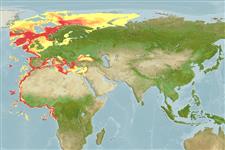
Benthopélagique; profondeur 20 - 4595 m (Réf. 81305). Tropical, preferred 20°C (Réf. 107945); 85°N - 6°S, 26°W - 158°E (Réf. 112293)
Northeast Atlantic, Mediterranean and the Arctic: Congo Dem Rep to Gibraltar, Mediterranean, Spain to Iceland, to Russian Arctic up to Sakha Republic.
Longueur à la première maturité / Taille / Poids / Âge
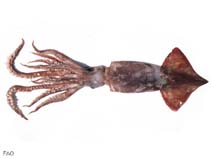
Maturité: Lm 23.2, range 20 - ? cm Max length : 75.0 cm ML mâle / non sexé; (Réf. 3722); poids max. publié: 2.2 kg (Réf. 120431); âge max. reporté: 2.00 années (Réf. 120431)
Common mantle length ranges between 25 and 35 cm (Ref. 3722). In the Mediterranean Sea no individual was caught in the hauls taken above a depth of 100 m (Ref. 81305). However, studies carried out in Norwegian waters indicated that it occurs in coastal and bank areas 80-200 m and even more superficially at 20-100 m (Ref.81307). It was also observed from the North Atlantic Ridge at a depth of 1947 m (Ref. 81308). Maximum depth from Ref. 1985. Demersal, neritic (Ref. 112172). Occurs from the surface to a depth of 2500 m (Ref. 2614). Juveniles feed mainly on fishes while adults consume crustaceans (Ref. 112351). Migrates to offshore waters during winter; spawning is thought to occur in the continental slope (Ref. 2614).
Cycle de vie et comportement reproducteur
Maturité | Reproduction | Frai | Œufs | Fécondité | Larves
Members of the class Cephalopoda are gonochoric. Male and female adults usually die shortly after spawning and brooding, respectively. Mating behavior: Males perform various displays to attract potential females for copulation. During copulation, male grasp the female and inserts the hectocotylus into the female's mantle cavity where fertilization usually occurs. Life cycle: Embryos hatch into planktonic stage and live for some time before they grow larger and take up a benthic existence as adults.
Schneider, W. 1990 FAO species identification sheets for fishery purposes. Field guide to the commercial marine resources of the Gulf of Guinea. Prepared and published with the support of the FAO Regional Office for Africa. Rome: FAO. 268 p. (Réf. 417)
Statut dans la liste rouge de l'IUCN
(Réf. 130435: Version 2025-2 (Global))
statut CITES (Réf. 108899)
Not Evaluated
Not Evaluated
Menace pour l'homme
Utilisations par l'homme
Pêcheries: commercial
FAO - pêcheries: landings search; Publication: search | FIRMS (Stock assessments) | FishSource | Sea Around Us
Outils
Plus d'informations
Dynamique des populations PhysiologieConsommation d'oxygène
Liées à l'hommeTimbres, pièces de monnaie, divers
Sources Internet
Estimations basées sur des modèles
Rate of population increase
|
Prior r = 0.38, 95% CL = 0.25 - 0.57, Based on 2 data-limited stock assessments. |
Vulnérabilité de la pêche
(Réf. 71543) |
Low to moderate vulnerability (30 of 100). |
Vulnérabilité climatique
(Réf. 125649) |
Low to moderate vulnerability (32 of 100) |
Catégorie de prix
(Réf. 80766): |
High. |
Nutrients
|
Calcium = 126 [75, 177] mg/100g; Iron = 4.79 [1.67, 7.92] mg/100g; Protein = 15.5 [13.7, 17.4] %; Omega3 = 0.414 [0.262, 0.566] g/100g; Selenium = 57.8 [48.5, 67.2] μg/100g; VitaminA = 0 μg/100g; Zinc = 1.97 [0.92, 3.02] mg/100g (wet weight); based on nutrient studies. |