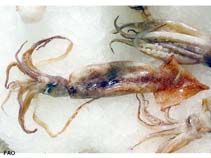
Cephalopoda |
Oegopsida |
Ommastrephidae | Illicinae
पर्यावरण: पर्यावरण / जलवायु क्षेत्र / गहराई सीमा / वितरण सीमा
पारिस्थितिकी
पिलाजिक; गहराई सीमा 0 - 1000 m (संदर्भ 275). Tropical, preferred 21°C (संदर्भ 107945); 70°N - 26°N, 81°W - 2°W (संदर्भ 275)
Atlantic Ocean: British Isles north to Iceland and Greenland.
प्रथम परिपक्वता पर लंबाई / आकार / वज़न / आयु
परिपक्व अवधि: Lm ? range ? - ? cm Max length : 27.0 cm ML पुल्लिंग / अलिंग; (संदर्भ 275); 31 cm ML (female)
Maximum mantle length is 31cm (females) and 27cm (males) in the northern part of its distributional range, but 20 cm (females) and 18cm (males) in the southern part (Ref. 3722). Feeds on euphausiids, capelin, herring, juvenile mackerel (Ref. 275).
जीवन चक्र और संभोग व्यवहार
परिपक्व अवधि | पुनरुत्पत्ति | मछलीऔ का अंडे देना | अंडे | उपजाऊपन | लार्वा
Members of the class Cephalopoda are gonochoric. Male and female adults usually die shortly after spawning and brooding, respectively. Mating behavior: Males perform various displays to attract potential females for copulation. During copulation, male grasp the female and inserts the hectocotylus into the female's mantle cavity where fertilization usually occurs. Life cycle: Embryos hatch into planktonic stage and live for some time before they grow larger and take up a benthic existence as adults.
Roper, C.F.E., M.J. Sweeney and C.E. Nauen 1984 FAO Species Catalogue. Vol. 3. Cephalopods of the world. An annotated and illustrated catalogue of species of interest to fisheries. FAO Fish. Synop. 125(3):277p. Rome: FAO. (संदर्भ 275)
आईयूसीएन रेड लिस्ट स्थिति
(संदर्भ 130435: Version 2025-2 (Global))
CITES स्थिति (संदर्भ 108899)
Not Evaluated
CMS (संदर्भ 116361)
Not Evaluated
मनुष्यों के लिए ख़तरा
मानव उपयोग
मात्स्यिकी: व्यापारिक
FAO - मात्स्यिकी: प्रजातियों की प्रोफ़ाइल, landings search; Publication: search | FIRMS (Stock assessments) | FishSource | हमारे चारों ओर समुद्र
साधन
अधिक जानकारी
जीवन चक्रपुनरुत्पत्तिपरिपक्व अवधिउपजाऊपनमछलीऔ का अंडे देनाअंडेअंडे का विकासलार्वा फिजियोलॉजीप्राणवायु की खपत
मानव संबंधीटिकट, सिक्के, विविध.
इंटरनेट स्रोत
मॉडल पर आधारित अनुमान
लौटाव
(Ref. 69278): |
ऊंचा, न्यूनतम जनसंख्या दुगनी समय अवलागत 15 महीने। (K=0.3-2.5) |
मछली पकड़ने की भेद्यता
(संदर्भ 71543) |
Low vulnerability (17 of 100). |
जलवायु भेद्यता
(संदर्भ 125649) |
(0 of 100) |
मूल्य श्रेणी
(संदर्भ 80766): |
Low. |
Nutrients
|
Calcium = 126 [75, 177] mg/100g; Iron = 4.79 [1.67, 7.92] mg/100g; Protein = 15.5 [13.7, 17.4] %; Omega3 = 0.414 [0.262, 0.566] g/100g; Selenium = 57.8 [48.5, 67.2] μg/100g; VitaminA = 0 μg/100g; Zinc = 1.97 [0.92, 3.02] mg/100g (wet weight); based on nutrient studies. |