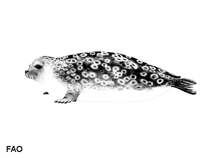
Mammalia |
Carnivora |
Phocidae
Miljö: miljö / Klimatzon / djupintervall / distributionsområde
Ekologi
Djupbottenlevande. Polar; 90°N - 0°S, 180°W - 180°E
Northeast Atlantic, Atlantic Ocean, Pacific Ocean and the Arctic: Svalbard, Hudson Bay and Strait (Canada), Bering and Baltic Seas (Ref. 1394). Pusa hispida hispida: Arctic Ocean, Bering Sea, North Pole, James Bay and Baffin Island (Nunavut), Strait of Belle Isle (Newfoundland), Greenland, Barents Sea, Norway, White Sea, Kamchatka, Bristol Bay in Alaska, and vagrant to Azores, Germany, Portugal, New Jersey, Southern California; Pusa hispida botnica: Baltic Sea, Gulf of Bothnia and Finland, Sweden, Latvia; Pusa hispida ladogensis: Russia, Gulf of Finland, Lake Ladoga, White Sea; Pusa hispida saimensis: Finland; Pusa hispida ochotensis: Sea of Okhotsk, Japan, Russia, Kamchatka, and vagrant to Jiangsu, China (Ref. 1522). Climate: Circumpolar, subtropical, boreal.
Längd vid första mognad / Storlek / Vikt / Ålder
Könsmognad: Lm ? range ? - ? cm Max length : 165 cm TL hane/ej könsbestämd; (Ref. 1394); publicerad maxvikt: 110.0 kg (Ref. 1394)
Feeds on fishes and planktonic crustaceans (Ref. 1394). Incidental injuries and death of this species are caused by commercial fishing gears, i.e., flatfish trawl, pollock trawl, cod trawl, and cod longline (Ref. 118427). Typically stays in ice-covered waters year-round (Ref. 117965). Feeds on fishes (Ref. 1394) and planktonic crustaceans like pelagic amphipods and mysids (Ref. 117965).
Livscykel och parningsbeteende
Könsmognad | Reproduktion | Lek | Ägg | Fekunditet | Larver
Jefferson, T.A., S. Leatherwood and M.A. Webber 1993 FAO species Identification Guide: Marine Mammals of the World. Rome, FAO. 320 p. + 587 figures. (Ref. 1394)
Status på IUCN:s rödlista
(Ref. 130435: Version 2025-2 (Global))
CITES-status (Ref. 108899)
Not Evaluated
Not Evaluated
Hot mot människor
Mänskliga användningsområden
Fiskeri: kommersiell
FAO - fiskeri: artprofil, landings search; Publication: search | FishSource | Havet omkring oss
Verktyg
Ytterligare information
LivscykelReproduktionKönsmognadFekunditetLekÄggUtveckling av äggLarver MänniskorelateradFrimärken, mynt, diverse.
Internet-källor
Uppskattningar baserade på modeller
Resiliens
(Ref. 69278): |
Mellan, lägsta populationsfördubblingstid 1,4-4,4 år (K=0.08-0.43) |
Sårbarhet i fisket
(Ref. 71543) |
High to very high vulnerability (75 of 100). |
Priskategori
(Ref. 80766): |
Unknown. |