Aves |
Charadriiformes |
Laridae
Milieu: milieu / Klimaatzone / Diepte / verspreidingsgebied
Ecologie
Others. Tropical; 33°N - 37°S, 104°E - 12°E
Indo-Pacific and Atlantic Ocean.
Lengte bij maturiteit / Grootte / Gewicht / Leeftijd
Maturiteit: Lm ? range ? - ? cm Max length : 39.0 cm TL mannelijk / geslacht onbekend; (Ref. 8812); max. gepubliceerd gewicht: 144.00 g (Ref. 356)
Culmen: 3.72 cm; tarsus: 2.5 cm; wing: 23.5 cm.
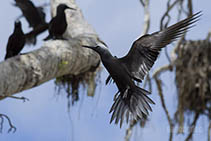
Total Length: 35 to 39 cm; Wingspan: 66 (Ref. 8812) to 76 cm (Refs. 84934, 91362). Total population is over 200,000 pairs (Ref. 84934). Coastal to <10 km offshore (Ref. 356). Found on coastal rock, and over sea (Ref. 83946). Breeds annually in dense colonies, preferably in bushes and trees in Atlantic and Pacific Oceans (Ref. 84934). They are double-brooded. When there is danger, alarm calls are given by adults and chicks respond by crouching in place (Ref. 87784). Highly pelagic. Typically feeds far out at sea in large, gregarious flocks over shoals of predatory fish (Ref. 91362). Exhibits dipping and surface-seizing foraging behavior (Ref. 356). Feed mainly by dipping, hovering and picking from or just below the surface of the water. Also, shallow-plunging (Ref. 126735).
Levenscyclus en paargedrag
Maturiteit | Voortplanting | Paaien | Eieren | Fecunditeit | Larven
Lusk, M.R., P. Bruner and C. Kessler 2000 The Avifauna of Farallon de Medinilla, Mariana Islands. Journal of Field Ornithology 71(1):22-33. (Ref. 5591)
Status op de Rode Lijst van het IUCN
(Ref. 130435: Version 2025-2 (Global))
CITES status (Ref. 108899)
Not Evaluated
Not Evaluated
Gevaar voor de mens
Gebruik door de mens
FAO - Publication: search | FishSource |
Tools
Meer informatie
PopulatiedynamicaGroeiMax. leeftijden / matenLengte-gewicht rel.Lengte-lengte rel.LengtefrequentiesMassaconversieAbundantie LevenscyclusVoortplantingMaturiteitFecunditeitPaaienEierenOntwikkeling van de eierenLarven FysiologieZuurstofverbruik
Menselijk gerelateerdPostzegels, munten, diversen.
Internetbronnen
Schattingen op basis van modellen
Weerstandsvermogen
(Ref. 69278): |
Hoog, minimale populatieverdubbelingstijd minder dan 15 maanden (K=42.36) |
Kwetsbaarheid van de visserij
(Ref. 71543) |
Low to moderate vulnerability (29 of 100). |
Prijsklasse
(Ref. 80766): |
Unknown. |