Malacostraca |
Stomatopoda |
Squillidae
Milieu: milieu / Klimaatzone / Diepte / verspreidingsgebied
Ecologie
Benthic; brak water; diepte 10 - 100 m (Ref. 3099). Subtropical; 46°N - 10°N, 106°E - 144°E
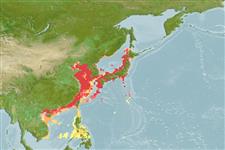
Western Pacific: from Vietnam to northern Japan, south to Bohol, Philippines. Introduced to Australia and New Zealand.
Lengte bij maturiteit / Grootte / Gewicht / Leeftijd
Maturiteit: Lm 9.6 range ? - ? cm Max length : 18.5 cm TL mannelijk / geslacht onbekend; (Ref. 3099)
Maximum depth from Ref. 80410. Demersal (Ref. 105264). Burrows in near-shore level-bottom substrates (Ref. 92) in sheltered embayment or estuaries (Ref. 3099). Occurs in muddy bottoms of bays and inlets (Ref. 105263). Feeds mainly on crustaceans, mollusks, polychaetes, and fish; occasionally on plant materials (Ref. 105093).
Levenscyclus en paargedrag
Maturiteit | Voortplanting | Paaien | Eieren | Fecunditeit | Larven
Some members of the order Stomatopoda pair for life and some come together only to mate. Males produce sperm ducts rather than spermatophores; females can brood a maximum of 50,000 eggs. Life cycle: Eggs hatch to a planktonic zoea which lasts for 3 months.
Manning, R.B. 1998 Stromatopods. p. 827-849. In Carpenter, K.E. and V.H. Niem (eds.) FAO Species Identifidication Guide for Fishery Purposes. The Living Marine Resources of the Western Central Pacific. Vol. 2. Cephalopods, crustaceans, holothurians and sharks. FAO Rome. (Ref. 92)
Status op de Rode Lijst van het IUCN
(Ref. 130435: Version 2025-2 (Global))
CITES status (Ref. 108899)
Not Evaluated
Not Evaluated
Gevaar voor de mens
Harmless
Gebruik door de mens
Visserij: commercieel
FAO - Publication: search | FishSource | Sea Around Us
Tools
Meer informatie
FysiologieZuurstofverbruik
Menselijk gerelateerdPostzegels, munten, diversen.
Internetbronnen
Schattingen op basis van modellen
Weerstandsvermogen
(Ref. 69278): |
Hoog, minimale populatieverdubbelingstijd minder dan 15 maanden (K=0.72-0.82) |
Kwetsbaarheid van de visserij
(Ref. 71543) |
Low vulnerability (13 of 100). |
Prijsklasse
(Ref. 80766): |
Very high. |
Nutrients
|
Calcium = 109 [35, 184] mg/100g; Iron = 1.59 [1.21, 1.97] mg/100g; Protein = 20.2 [19.2, 21.3] %; Omega3 = 0.285 [0.185, 0.386] g/100g; Selenium = 48.3 [-31.7, 128.3] μg/100g; VitaminA = 0 μg/100g; Zinc = 1.79 [1.17, 2.40] mg/100g (wet weight); based on nutrient studies. |