Malacostraca |
Decapoda |
Portunidae
Entorno: milieu / zona climática / rango de profundidad / gama de distribución
Ecología
Bentopelágico; rango de profundidad 0 - 100 m (Referencia 132434). Tropical, preferred 24°C (Referencia 107945); 42°N - 38°S, 79°E - 154°E (Referencia 106948)
Distribución
Territories | Áreas FAO | Ecosistemas | Ocurrencias, apariciones | Introducciones
Indo-West Pacific: from Honshu, Japan, west to eastern India and Sri Lanka, and south to New South Wales, Australia.
Longitud en la primera madurez / Tamaño / Peso / Edad
Madurez: Lm 13.1 range ? - ? cm Max length : 15.9 cm CW macho / no sexado; (Referencia 125642)
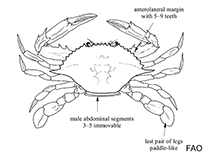
Carapace tough to granulose, regions discernible; front with 3 acutely triangular teeth; 9 teeth on each anterolateral margin, the last tooth much larger than preceding teeth. Larger chela with conical tooth at base of fingers; pollex ridged. Color: carapace dull green to brown.
Minimum depth assumed from its ecology. Shallow waters up to depths of 50 m. Inhabits sandy to sandy-muddy substrates (Ref. 343). Benthopelagic predator, feeding mainly on bivalves (Lamellibranchia), benthic crustaceans, fishes and cephalopods (Ref. 117071).
Ciclo vital y comportamiento de apareamiento
Madurez | Reproducción | Puesta | Huevos | Fecundidad | Larva
Members of the order Decapoda are mostly gonochoric. Mating behavior: Precopulatory courtship ritual is common (through olfactory and tactile cues); usually indirect sperm transfer.
Ng, P.K.L. 1998 Crabs. p. 1045-1155. In K.E. Carpenter and V.H. Niem (eds) FAO species identification guide for fishery purposes. The living marine resources of the Western Central Pacific. Volume 2. Cephalopods, crustaceans, holothurians and sharks. Rome, FAO. 1998. pp. 687-1396. (Referencia 343)
Situación en la Lista Roja de la UICN
(Referencia 130435: Version 2025-2 (Global))
Estatus CITES (Referencia 108899)
Not Evaluated
CMS (Referencia 116361)
Not Evaluated
Amenaza para el ser humano
Harmless
Usos humanos
Pesquerías: comercial
FAO - Aquaculture Systems: production searchpesquerías: perfil de la especie, landings search; Publication: search | FishSource | Sea Around Us
Herramientas
Más información
FisiologíaConsumo del oxígeno
Relacionados con el ser humanoSellos, monedas, varios
Fuentes de Internet
Estimaciones basadas en modelos
Resiliencia
(Ref. 69278): |
Alto, población duplicada en un tiempo mínimo inferior a 15 meses (K=0.44-1.76) |
Rate of population increase
|
Prior r = 1.19, 95% CL = 0.79 - 1.79, Based on 2 data-limited stock assessments. |
Vulnerabilidad pesquera
(Referencia 71543) |
Low vulnerability (10 of 100). |
Vulnerabilidad climática
(Referencia 125649) |
Low to moderate vulnerability (33 of 100) |
Categoría de precios
(Referencia 80766): |
Very high. |
Nutrients
|
Calcium = 109 [35, 184] mg/100g; Iron = 1.59 [1.21, 1.97] mg/100g; Protein = 20.2 [19.2, 21.3] %; Omega3 = 0.285 [0.185, 0.386] g/100g; Selenium = 48.3 [-31.7, 128.3] μg/100g; VitaminA = 0 μg/100g; Zinc = 1.79 [1.17, 2.40] mg/100g (wet weight); based on nutrient studies. |