Bivalvia |
Arcida |
Arcidae
Lingkungan: lingkungan / zona iklim / kisaran kedalaman / jangkauan distribusi
Ekologi
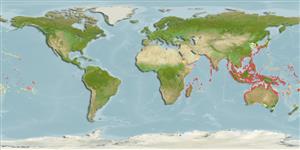
Benthic; payau; kisaran kedalaman 0 - 20 m (Acuan 101198). Tropical, preferred 27°C (Acuan 107945); 46°N - 39°S, 26°E - 134°W (Acuan 106948)
Indo-Pacific.
Panjang pada saat jatuh tempo pertama / Ukuran / Berat / umur
Kematangan: Lm ?, range 2 - 2.1 cm Max length : 9.0 cm SHL jantan/; (Acuan 348); common length : 6.0 cm SHL jantan/; (Acuan 348); Umur maksimum dilaporkan: 12 Tahun (Acuan 126573)
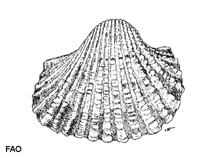
Shell equivalve, thick and solid, ovate, strongly inflated, slightly longer than high and feebly inequilateral. Umbones strongly protruding, cardinal area rather large. About 18 radial ribs (15 to 20) with wide interstices at each valve; ribs stout and distinctly rugose, bearing regular, often rectangular nodules. Periostracum rather thin and smooth. Internal margins with strong crenulations corresponding with the external radial ribs. No byssal gape. Colour: outside of shell white under the yellowish brown periostracum. Inner side white, often tinged yellow towards the umbonal cavity.
This represents the most important commercial ark (Ref. 348). Lives in intertidal and shallow subtidal waters. On muddy bottoms, mainly in protected bays and estuaries, or in mangroves. Often occurring in dense populations (Ref. 348). Typically found in the intertidal with silty bottoms with low salinity. A filter-feeder and a shallow burrower. Primarily feeds on organic detritus, phytoplankton and detritus (Ref. 101198).
Members of the class Bivalvia are mostly gonochoric, some are protandric hermaphrodites. Life cycle: Embryos develop into free-swimming trocophore larvae, succeeded by the bivalve veliger, resembling a miniature clam.
rujukan utama
Acuan | Koordinator | mitra
Poutiers, J.M. 1998 Bivalves. Acephala, Lamellibranchia, Pelecypoda. p. 123-362. In Carpenter, K. E. and V. H. Niem. 1998. FAO species identification guide for fishery purposes. The living marine resources of the Western Central Pacific. Volume 1. Seaweeds, corals, bivalves, and gastropods. Rome, FAO. (Acuan 348)
Status IUCN Red List
(Acuan 130435: Version 2025-2 (Global))
status CITES (Acuan 108899)
Not Evaluated
Not Evaluated
ancaman kepada manusia
Harmless
penggunaan manusia
Perikanan: komersial
FAO - Aquaculture Systems: production searchPerikanan: profail spesis, landings search; Publication: search | FishSource | Laut di Sekitar Kita
Alat, peralatan
informasi lanjut
FisiologiKonsumsi oksigen
Yang berhubungan dengan manusiaPerangko, koin, dll.
Sumber internet
Estimasi berdasarkan model
Daya lenting
(Ref. 69278): |
Tinggi, Waktu penggandaan populasi minimum kurang dari 15 bulan (K=0.54-4.34; tm=0.6; tmax=12) |
Rate of population increase
|
Prior r = 0.85, 95% CL = 0.56 - 1.28, Based on 2 data-limited stock assessments. |
Kerentanan Penangkapan Ikan
(Acuan 71543) |
Low to moderate vulnerability (28 of 100). |
Kerentanan Iklim
(Acuan 125649) |
High vulnerability (61 of 100) |
kategori harga
(Acuan 80766): |
Medium. |
Nutrients
|
Calcium = 149 [71, 228] mg/100g; Iron = 8.53 [1.95, 15.11] mg/100g; Protein = 9.88 [8.64, 11.12] %; Omega3 = 0.313 [0.202, 0.423] g/100g; Selenium = 61 [50, 72] μg/100g; VitaminA = 0 μg/100g; Zinc = 2.04 [0.56, 3.51] mg/100g (wet weight); based on nutrient studies. |