Bivalvia |
Arcida |
Arcidae
Môi trường: môi trường / vùng khí hậu / Mức độ sâu / phạm vi phân phối
Sinh thái học
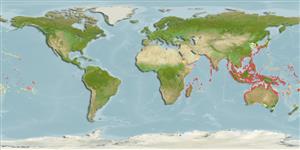
Benthic; thuộc về nước lợ; mức độ sâu 0 - 20 m (Tài liệu tham khảo 101198). Tropical, preferred 27°C (Tài liệu tham khảo 107945); 46°N - 39°S, 26°E - 134°W (Tài liệu tham khảo 106948)
Indo-Pacific.
Chiều dài lúc trưởng thành đầu tiên / Bộ gần gũi / Khối lượng (Trọng lượng) / Tuổi
Chín muồi sinh dục: Lm ?, range 2 - 2.1 cm Max length : 9.0 cm SHL con đực/không giới tính; (Tài liệu tham khảo 348); common length : 6.0 cm SHL con đực/không giới tính; (Tài liệu tham khảo 348); Tuổi cực đại được báo cáo: 12 các năm (Tài liệu tham khảo 126573)
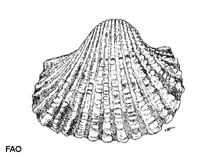
Shell equivalve, thick and solid, ovate, strongly inflated, slightly longer than high and feebly inequilateral. Umbones strongly protruding, cardinal area rather large. About 18 radial ribs (15 to 20) with wide interstices at each valve; ribs stout and distinctly rugose, bearing regular, often rectangular nodules. Periostracum rather thin and smooth. Internal margins with strong crenulations corresponding with the external radial ribs. No byssal gape. Colour: outside of shell white under the yellowish brown periostracum. Inner side white, often tinged yellow towards the umbonal cavity.
This represents the most important commercial ark (Ref. 348). Lives in intertidal and shallow subtidal waters. On muddy bottoms, mainly in protected bays and estuaries, or in mangroves. Often occurring in dense populations (Ref. 348). Typically found in the intertidal with silty bottoms with low salinity. A filter-feeder and a shallow burrower. Primarily feeds on organic detritus, phytoplankton and detritus (Ref. 101198).
Members of the class Bivalvia are mostly gonochoric, some are protandric hermaphrodites. Life cycle: Embryos develop into free-swimming trocophore larvae, succeeded by the bivalve veliger, resembling a miniature clam.
Poutiers, J.M. 1998 Bivalves. Acephala, Lamellibranchia, Pelecypoda. p. 123-362. In Carpenter, K. E. and V. H. Niem. 1998. FAO species identification guide for fishery purposes. The living marine resources of the Western Central Pacific. Volume 1. Seaweeds, corals, bivalves, and gastropods. Rome, FAO. (Tài liệu tham khảo 348)
Tình trạng Sách đỏ IUCN
(Tài liệu tham khảo 130435: Version 2025-2 (Global))
tình trạng CITES (Tài liệu tham khảo 108899)
Not Evaluated
CMS (Tài liệu tham khảo 116361)
Not Evaluated
Mối đe dọa đối với con người
Harmless
Sử dụng của con người
Các nghề cá: tính thương mại
FAO - Aquaculture Systems: production searchCác nghề cá: hồ sơ loài, landings search; Publication: search | FishSource | Biển chung quanh ta
Các công cụ
Thêm thông tin
Sinh lý họcThành phần ô-xy
Liên quan đến con ngườiTem, tiền xu, v.v.
Các nguồn internet
Ước tính dựa trên mô hình
Thích nghi nhanh
(Ref. 69278): |
Chiêù cao, thời gian nhân đôi của chủng quần tối thiểu là dưới 15 tháng (K=0.54-4.34; tm=0.6; tmax=12) |
Rate of population increase
|
Prior r = 0.85, 95% CL = 0.56 - 1.28, Based on 2 data-limited stock assessments. |
Sự dễ bị tổn thương của nghề đánh cá
(Tài liệu tham khảo 71543) |
Low to moderate vulnerability (28 of 100). |
Sự dễ bị tổn thương của khí hậu
(Tài liệu tham khảo 125649) |
High vulnerability (61 of 100) |
Loại giá
(Tài liệu tham khảo 80766): |
Medium. |
Nutrients
|
Calcium = 149 [71, 228] mg/100g; Iron = 8.53 [1.95, 15.11] mg/100g; Protein = 9.88 [8.64, 11.12] %; Omega3 = 0.313 [0.202, 0.423] g/100g; Selenium = 61 [50, 72] μg/100g; VitaminA = 0 μg/100g; Zinc = 2.04 [0.56, 3.51] mg/100g (wet weight); based on nutrient studies. |