Bivalvia |
Pectinida |
Pectinidae
Environnement : milieu / zone climatique / profondeur / gamme de distribution
Écologie
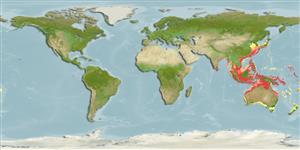
Benthic; profondeur 10 - 160 m (Réf. 348). Tropical; 31°N - 21°S, 92°E - 156°E
Indo-West Pacific: from Myanmar to Dampier Archipelago, north to southern Japan and east to Papua New Guinea.
Longueur à la première maturité / Taille / Poids / Âge
Maturité: Lm ?, range 5 - ? cm Max length : 10.0 cm ShL mâle / non sexé; (Réf. 348); common length : 8.0 cm SL mâle / non sexé; (Réf. 348); âge max. reporté: 2.00 années (Réf. 84612)
Description synthétique
Morphologie
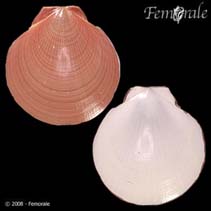
Shell thin, medium sized (commonly attaining 8 cm in length), laterally compressed, almost circular in outline, gaping anteriorly and posteriorly. Both valves somewhat convex, the right (lower) valve only a little more inflated and large than the left (upper) valve. Ears moderately small, subequal in size and shape, with the right anterior ear slightly sinuated anteroventrally and devoid of ctenolium. Surface of left valve with 2 broad and very shallow depressed areas radiating from the umbo to anteroventral and posteroventral margins. Outside of shell polished and nearly smooth, with only many faint concentric and radial lines. Interior of both valves with distinct radial ribs, usually in pairs, much narrower than the flat interstices and becoming obsolete on umbonal area. Right valve with 22 to 34 internal radial ribs (usually 26 to 34 in the typical subspecies Amusium pleuronectes pleuronectes, and 22 to 24 in the southern subspecies A. pleuronectes australiae). Colour: outside of left valve with light to deep pinky brown of varying shades along concentric growth marks, and with darker radial lines and tiny white dots on umbonal area. Interior of left valve whitish, often with a pinkish hue on margins and central area, and with a brown blotch under the hinge. Right valve white externally and internally.
Maximum depth from Ref. 101147. It is part of trawl bycatch (Ref. 128042). Widely distributed in Indo-Pacific coasts (Ref. 122164). Occurs in large schools in shallow waters with sand and muddy bottoms (Ref. 80041). Also found on clean sand with silt and shell rubble, where the lower right valve is buried in soft sediment (Ref. 101147) as well as on river mouth and estuary (Ref. 122165).
Cycle de vie et comportement reproducteur
Maturité | Reproduction | Frai | Œufs | Fécondité | Larves
Spawning occurs throughout the year (Ref. 84612). Life cycle: Embryos develop into free-swimming trocophore larvae, succeeded by the bivalve veliger, resembling a miniature clam (Ref. 833).
Poutiers, J.M. 1998 Bivalves. Acephala, Lamellibranchia, Pelecypoda. p. 123-362. In Carpenter, K. E. and V. H. Niem. 1998. FAO species identification guide for fishery purposes. The living marine resources of the Western Central Pacific. Volume 1. Seaweeds, corals, bivalves, and gastropods. Rome, FAO. (Réf. 348)
Statut dans la liste rouge de l'IUCN
(Réf. 130435: Version 2025-2 (Global))
statut CITES (Réf. 108899)
Not Evaluated
Not Evaluated
Menace pour l'homme
Harmless
Utilisations par l'homme
Pêcheries: commercial
FAO - Publication: search | FishSource |
Outils
Plus d'informations
Dynamique des populations PhysiologieConsommation d'oxygène
Liées à l'hommeTimbres, pièces de monnaie, divers
Sources Internet
Estimations basées sur des modèles
Résilience
(Ref. 69278): |
Haut, temps minimum de doublement de population inférieur à 15 mois (K=0.92-1.3; tm=1; tmax=2) |
Vulnérabilité de la pêche
(Réf. 71543) |
Low vulnerability (10 of 100). |
Catégorie de prix
(Réf. 80766): |
Medium. |