Malacostraca |
Stomatopoda |
Squillidae
Milieu: milieu / Klimaatzone / Diepte / verspreidingsgebied
Ecologie
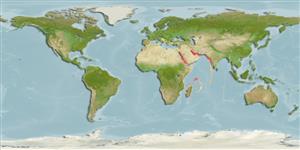
Benthic; diepte 9 - 200 m (Ref. 128606), usually 20 - 40 m (Ref. 3497). Subtropical; 30°N - 13°N, 32°E - 44°E
Western Indian Ocean: Red Sea. Introduced in the Mediterranean.
Lengte bij maturiteit / Grootte / Gewicht / Leeftijd
Maturiteit: Lm ? range ? - ? cm Max length : 21.6 cm TL mannelijk / geslacht onbekend; (Ref. 365); common length : 15.0 cm TL mannelijk / geslacht onbekend; (Ref. 365)
Length: common up to 15 cm (Ref. 363).
Even if it currently does not have a commercial importance in the Mediterranean (rare on the markets of Cyprus, Israel and Turkey), this species can have a potential importance for fishing. Common on the markets of Suez and lsmaïlia. Maximum depth from Ref. 122160. Prefers soft bottoms in coastal waters but also tolerates open waters and sheltered brackish areas (Ref. 122163). Above muddy, sandy, argillaceous funds and of gravel at depths of 10 to 50 m (Ref. 365). Also over sandy-silt bottoms at depths between 150 and 200 m (Ref. 122160).
Levenscyclus en paargedrag
Maturiteit | Voortplanting | Paaien | Eieren | Fecunditeit | Larven
Some members of the order Stomatopoda pair for life and some come together only to mate. Males produce sperm ducts rather than spermatophores; females can brood a maximum of 50,000 eggs. Life cycle: Eggs hatch to a planktonic zoea which lasts for 3 months.
Manning, R.B. 1995 Stomatopod Crustacea of Vietnam: the legacy of Raoul Serène. Crustacean Research (Special No. 4): 1-339, figs. 1-142, pl. 1-38. (Ref. 3145)
Status op de Rode Lijst van het IUCN
(Ref. 130435: Version 2025-2 (Global))
CITES status (Ref. 108899)
Not Evaluated
Not Evaluated
Gevaar voor de mens
Harmless
Gebruik door de mens
Visserij: commercieel
FAO - Publication: search | FishSource |
Tools
Meer informatie
Trofische ecologieVoedsel (prooien)
Dieetsamenstelling
Voedselconsumptie
Predatoren
LevenscyclusVoortplantingMaturiteitFecunditeitPaaienEierenOntwikkeling van de eierenLarven FysiologieZuurstofverbruik
Menselijk gerelateerdPostzegels, munten, diversen.
Internetbronnen
Schattingen op basis van modellen
Kwetsbaarheid van de visserij
(Ref. 71543) |
Low vulnerability (12 of 100). |
Prijsklasse
(Ref. 80766): |
Very high. |