Malacostraca |
Stomatopoda |
Squillidae
Umwelt: Milieu / Klimazone / Tiefenbereich / Verbreitungsgebiet
Ökologie
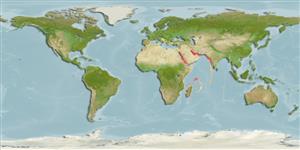
Benthic; tiefenbereich 9 - 200 m (Ref. 128606), usually 20 - 40 m (Ref. 3497). Subtropical; 30°N - 13°N, 32°E - 44°E
Western Indian Ocean: Red Sea. Introduced in the Mediterranean.
Länge bei der ersten Reifung / Größe / Gewicht / Alter
Geschlechtsreife: Lm ? range ? - ? cm Max length : 21.6 cm TL Männchen/unbestimmt; (Ref. 365); common length : 15.0 cm TL Männchen/unbestimmt; (Ref. 365)
Length: common up to 15 cm (Ref. 363).
Even if it currently does not have a commercial importance in the Mediterranean (rare on the markets of Cyprus, Israel and Turkey), this species can have a potential importance for fishing. Common on the markets of Suez and lsmaïlia. Maximum depth from Ref. 122160. Prefers soft bottoms in coastal waters but also tolerates open waters and sheltered brackish areas (Ref. 122163). Above muddy, sandy, argillaceous funds and of gravel at depths of 10 to 50 m (Ref. 365). Also over sandy-silt bottoms at depths between 150 and 200 m (Ref. 122160).
Lebenszyklus und Paarungsverhalten
Geschlechtsreife | Fortpflanzung | Ablaichen | Eier | Fruchtbarkeit | Larven
Some members of the order Stomatopoda pair for life and some come together only to mate. Males produce sperm ducts rather than spermatophores; females can brood a maximum of 50,000 eggs. Life cycle: Eggs hatch to a planktonic zoea which lasts for 3 months.
Manning, R.B. 1995 Stomatopod Crustacea of Vietnam: the legacy of Raoul Serène. Crustacean Research (Special No. 4): 1-339, figs. 1-142, pl. 1-38. (Ref. 3145)
IUCN Rote Liste Status
(Ref. 130435: Version 2025-2 (Global))
CITES Status (Ref. 108899)
Not Evaluated
Not Evaluated
Bedrohung für Menschen
Harmless
Nutzung durch Menschen
Fischereien: kommerziell
FAO - Publication: search | FishSource |
Tools
Mehr Information
Trophische ÖkologieLebensmittel (Beutetiere)
Nahrungszusammensetzung
Nahrungsaufnahme
Räuber
PopulationsdynamikWachstumMax. Alter/GrößenLänge-Gewicht-Rel.Länge-Länge-Verhältnis.LängenhäufigkeitenMassenkonvertierungDichte LebenszyklusFortpflanzungGeschlechtsreifeFruchtbarkeitAblaichenEierEientwicklungLarven PhysiologieSauerstoffverbrauch
MenschenbezogenBriefmarken, Münzen, Verschiedenes.
Internet Quellen
Schätzungen auf der Grundlage von Modellen
Anfälligkeit der Fischerei
(Ref. 71543) |
Low vulnerability (12 of 100). |
Preiskategorie
(Ref. 80766): |
Very high. |