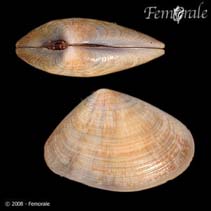
Bivalvia |
Cardiida |
Donacidae
Environnement : milieu / zone climatique / profondeur / gamme de distribution
Écologie
Benthic. Tropical
Indo-West Pacific: New Caledonia; north to southern Japan and south to New South Wales.
Longueur à la première maturité / Taille / Poids / Âge
Maturité: Lm ? range ? - ? cm Max length : 2.5 cm SHL mâle / non sexé; (Réf. 348); common length : 2.0 cm SHL mâle / non sexé; (Réf. 348)
Intertidal, on sand and mud (Ref. 75840). On sandy beaches, in all but the most sheltered areas, often in dense populations. Most common in wave-beaten areas, migrating up and down the beach with the tide. Frequently preyed upon by crabs and birds during migration (Ref. 345). Confined on beaches with coarse, poorly-sorted sediments (Ref. 125508).
Cycle de vie et comportement reproducteur
Maturité | Reproduction | Frai | Œufs | Fécondité | Larves
Members of the class Bivalvia are mostly gonochoric, some are protandric hermaphrodites. Life cycle: Embryos develop into free-swimming trocophore larvae, succeeded by the bivalve veliger, resembling a miniature clam.
Poutiers, J.M. 1998 Bivalves. Acephala, Lamellibranchia, Pelecypoda. p. 123-362. In Carpenter, K. E. and V. H. Niem. 1998. FAO species identification guide for fishery purposes. The living marine resources of the Western Central Pacific. Volume 1. Seaweeds, corals, bivalves, and gastropods. Rome, FAO. (Réf. 348)
Statut dans la liste rouge de l'IUCN
(Réf. 130435: Version 2025-2 (Global))
statut CITES (Réf. 108899)
Not Evaluated
Not Evaluated
Menace pour l'homme
Harmless
Utilisations par l'homme
FAO - Publication: search | FishSource |
Outils
Plus d'informations
Écologie trophiqueAliments (proies)Composition du régime alimentaireConsommation alimentairePrédateurs Dynamique des populations Cycle de vieReproductionMaturitéFéconditéFraiŒufsDéveloppement de l'œufLarves PhysiologieConsommation d'oxygène
Liées à l'hommeTimbres, pièces de monnaie, divers
Sources Internet
Estimations basées sur des modèles
Résilience
(Ref. 69278): |
Haut, temps minimum de doublement de population inférieur à 15 mois (K=0.89-1.2) |
Vulnérabilité de la pêche
(Réf. 71543) |
Low vulnerability (19 of 100). |
Catégorie de prix
(Réf. 80766): |
Medium. |