Scyphozoa |
Rhizostomeae |
Rhizostomatidae
Miljö: miljö / Klimatzon / djupintervall / distributionsområde
Ekologi
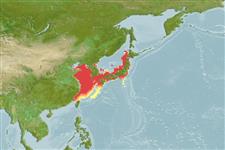
Pelagiska; djupintervall 0 - 176 m (Ref. 122799). Subtropical; 52°N - 29°N, 117°E - 142°E (Ref. 121705)
Northwest Pacific: endemic to the East Asian Marginal Seas.
Längd vid första mognad / Storlek / Vikt / Ålder
Könsmognad: Lm ? range ? - ? cm Max length : 200 cm WD hane/ej könsbestämd; (Ref. 99323); publicerad maxvikt: 200.0 kg (Ref. 3010); rapporterad maxålder: 1.00 år (Ref. 100320)
One of the largest jellyfish species (Ref. 3010). Occurrence of jellyfish bloom has threatened the fisheries in Japan since early 2000s, possibly because of global warming - note that the growth of medusae are dependent on high temperatures (Ref. 100320). Occurs in semi-enclosed basins of marginal seas (Ref. 122853) and also found offshore (Ref. 122855). Before the chitin-covered podocysts develop into adults, they remain dormant for at least 6 years. Jellyfish blooms occur by mass excystment of these podocysts upon exposure to high temperatures (Ref. 100312).
Livscykel och parningsbeteende
Könsmognad | Reproduktion | Lek | Ägg | Fekunditet | Larver
Life cycle: Fertilized egg develops into a planula larva after 1 day. Planula swims for 4 to 8 days until it becomes a translucent, whitish and dome-shaped scyphistoma and settles at the bottom. Becomes a fully-developed scyphistoma after 10 to 20 days of settlement. Also exhibits asexual reproduction by means of podocyst formation (as many as 18 podocysts on a single original scyphistoma within 7 days to 3 months). Scyphistoma colony develops from podocyst of original scyphistoma within 6 months at 18°C. Fully-developed scyphistoma develops into a strobila after a day and becomes a liberated ephyra with 5 to 7 days. Becomes a fully-developed metaphyra within 30 days of post-liberation and becomes a young medusa within 40 to 50 days of post-liberation (Ref. 3004). Furthermore, ephyrae are released into the plankton during early summer. After subsequent sexual reproduction, the medusae die during winter. The life span of the medusae is less than a year (Ref. 100320).
Kawahara, M., S.-I. Uye, K. Ohtsu and H. Iizumi 2006 Unusual population explosion of the giant jellyfish Nemopilema nomurai (Scyphozoa: Rhizostomeae). Mar. Ecol. Prog. Ser. 307:161-173. (Ref. 3004)
Status på IUCN:s rödlista
(Ref. 130435: Version 2025-2 (Global))
CITES-status (Ref. 108899)
Not Evaluated
Not Evaluated
Hot mot människor
Harmless
Mänskliga användningsområden
Fiskeri: kommersiell
FAO - Publication: search | FishSource |
Verktyg
Ytterligare information
MänniskorelateradFrimärken, mynt, diverse.
Internet-källor
Uppskattningar baserade på modeller
Sårbarhet i fisket
(Ref. 71543) |
Moderate to high vulnerability (50 of 100). |
Priskategori
(Ref. 80766): |
Unknown. |